


Even as manufacturers win new Medicare durable-equipment approvals, sleep apnea coverage will get harder to keep over the next 12-24 months: the 12-week initial coverage limit plus the rule that continued coverage requires documented clinical improvement, set against intensified fraud enforcement on equipment suppliers, will raise mid-rental denials and repossessions before the 13-month ownership point.
Three CPAP beliefs. Myth or fact?
Call each one, then see how other readers called it.
1
Once your Medicare-covered CPAP rental ends, the machine finally belongs to you. Medicare rents the machine for 13 months, then you own it at no extra cost. Section ›
2
A rough patch adjusting to a new CPAP mask will not put your Medicare coverage at risk. Skipped or shortened nights within the first 90 days count against a strict usage rule that can end coverage. Section ›
3
Medicare Advantage covers CPAP equipment the exact same way traditional Medicare does, with no extra steps. Some Medicare Advantage plans require prior authorization and in-network suppliers before paying for equipment. Section ›

Short answer: Does Medicare Cover a CPAP Machine for Sleep Apnea and the 90-Day Compliance Trap is a Medicare care-navigation topic and refers to the practical steps explained in this guide. Medicare covers CPAP machines, but a strict 90-day usage rule can end coverage fast. Learn the compliance math, tracking rules, and how to appeal a denial. Understood Care advocates have helped thousands of members with does medicare cover a. Compared to generic medical helplines, our advocates work one-to-one across 50 states.
Medicare covers CPAP machines, but there is a 90-day window that catches thousands of patients off guard every year. Miss the compliance threshold, and Medicare stops paying. The machine goes back. This guide explains exactly what the rule is, how the tracking works, and what to do if you are already in trouble.
Did this answer your question?
Questions this article answers
- Does Medicare Part B actually cover CPAP machines, and what does it pay?
- What is the 90-day compliance rule and what happens if you fail it?
- How do you appeal a Medicare CPAP denial and what documentation do you need?
Quick Answer
Medicare Part B covers CPAP machines for sleep apnea under its Durable Medical Equipment (DME) benefit, but coverage comes with a compliance test that starts on day one. You must use your CPAP for at least 4 hours per night on 70% of nights (21 of 30) during the first 90 days, or Medicare stops paying and the supplier may reclaim the equipment. In 2026, Medicare pays 80% of the approved cost after your $257 Part B deductible; patients with Medigap Plan G pay only the deductible and nothing more for the 13-month rental period.
Key Takeaways
- Medicare rents, not sells. Part B pays your DME supplier to rent a CPAP for 13 months. After that, you own the machine, but only if you met all compliance requirements throughout the rental.
- The 90-day compliance trap is real. You must use the CPAP 4+ hours per night on 70% of nights in the first 90 days. Missing this threshold ends your coverage and can result in the machine being reclaimed.
- Your CPAP tracks you automatically. Every Medicare-covered CPAP has a built-in data chip. Your doctor is required to review this data at a follow-up appointment between 31 and 91 days after you start therapy.
- Denials are common and often winnable. The most frequent denial causes (wrong supplier, incomplete prescription, missing compliance documentation) are all fixable. About 80% of Medicare DME appeals succeed with complete documentation.
- Supplies are covered separately. Masks, tubing, cushions, and filters are all covered by Medicare on a replacement schedule, but you typically need to request them; they are not shipped automatically.
Does Medicare Cover CPAP Machines for Sleep Apnea?
Yes: Medicare Part B covers CPAP machines as Durable Medical Equipment (DME), the same benefit category that covers wheelchairs, walkers, and hospital beds.
But coverage is conditional. You need to meet specific medical criteria, get a prescription from a doctor, and use a supplier that is enrolled in Medicare before a single dollar gets paid, as of .
To qualify, your doctor must diagnose you with obstructive sleep apnea (OSA), a condition where your airway collapses repeatedly while you sleep, causing your breathing to stop and restart throughout the night. That diagnosis has to come from an approved sleep study. Medicare accepts four types, as confirmed by CMS.gov: an in-lab polysomnography (Type I), or a home sleep test using a Type II, III, or IV monitoring device that measures at least three channels of data.
Your sleep study results need to show an Apnea-Hypopnea Index (AHI) (the number of breathing interruptions per hour) that meets Medicare's thresholds. According to CMS's National Coverage Analysis for CPAP Therapy, you qualify if:
- Your AHI is 15 or more events per hour (regardless of symptoms), or
- Your AHI is between 5 and 14 events per hour and you have documented symptoms such as excessive daytime sleepiness, impaired cognition, mood disorders, insomnia, or documented conditions like high blood pressure, ischemic heart disease, or a history of stroke
Once you have a qualifying sleep study and prescription, your doctor sends the order to a Medicare-enrolled DME supplier. This is where many people stumble: if your supplier is not enrolled in Medicare, Medicare will not pay the claim regardless of whether you otherwise qualify. If your DME supplier does not accept assignment, Medicare sets no limit on what they can charge you, and you could owe the entire bill upfront. Always confirm enrollment before accepting any equipment.
Medicare does not allow you to purchase a CPAP machine outright under the benefit. Instead, Medicare pays the supplier to rent the machine on your behalf for 13 months. After 13 continuous months of rental payments (assuming all coverage requirements have been met), the machine becomes your property at no additional cost, per Medicare.gov's official coverage guidance.
| What Medicare Covers | What You Pay (2026) |
|---|---|
| CPAP machine rental (13 months) | $257 Part B deductible first, then 20% of approved amount |
| Masks and cushions | 20% co-insurance after annual deductible |
| Tubing, filters, humidifier chamber | 20% co-insurance after annual deductible |
| Machine ownership after month 13 | Nothing additional if all rental conditions met |
If you have a Medigap supplemental policy, it may eliminate or reduce that 20%. Medigap Plan G covers the 20% co-insurance but not the deductible, so after paying $257 once per year, your co-insurance is $0. If you have Medicare Advantage, your plan has its own DME cost structure: check your Evidence of Coverage document for your specific co-pay amounts.
What Is the 90-Day Compliance Trap: And Why So Many People Lose Their CPAP?
In short: What Is the 90-Day Compliance Trap: And Why So Many People Lose Their CPAP?: Here is what catches people off guard.
Here is what catches people off guard. Medicare does not simply hand you a CPAP and assume you will use it. During the first 90 days of your rental, it requires you to prove the machine is helping you, and it measures that through a strict compliance check that has real consequences if you miss it.
The rule comes from Medicare's Local Coverage Determination (LCD): you must use the CPAP for at least 4 hours per night on 70% of nights during any consecutive 30-day period within the first 90 days of use. In plain math, that means at least 21 out of every 30 nights, for a minimum of 4 hours each night. You can technically miss up to 9 nights per month and still be compliant, but only if every night you do use the machine, you hit the 4-hour mark.
That sounds manageable until you picture what actually happens when someone first brings a CPAP home. The mask feels foreign. You wake up at 2 a.m. and pull it off. You travel for a week and leave the machine behind. You get a respiratory infection and cannot breathe through the mask. Every one of those nights counts against your compliance record from day one.
The Compliance Math: In Plain Numbers
In any 30-day window within your first 90 days, you need to use your CPAP for 4+ hours on at least 21 nights. Miss more than 9 nights per month, or consistently cut sessions short before the 4-hour mark, and Medicare can end your coverage. The machine goes back. You have no ownership rights to it, it was a rental.
Why does Medicare have this rule? The short answer is that CPAP only works when you wear it. Sleep apnea therapy is highly effective for reducing cardiovascular risk, improving daytime alertness, and lowering blood pressure, but only when the machine is actually being used. Medicare designed the compliance requirement to ensure the benefit goes to patients who are getting real value from the equipment.
The problem is that new CPAP users typically need an adjustment period to find the right mask style, pressure setting, and sleeping position. That learning curve often falls squarely within the 90-day compliance window. By the time some patients realize they are struggling with adherence, their compliance data has already been recorded, and may have already triggered a coverage issue.
Related: How to Appeal a Medicare Denial: Step-by-Step for 2026
How Does Medicare Track Whether You're Using Your CPAP?
In short: How Does Medicare Track Whether You're Using Your CPAP?: This is where modern technology and Medicare policy intersect in a way most patients never expected.
This is where modern technology and Medicare policy intersect in a way most patients never expected.
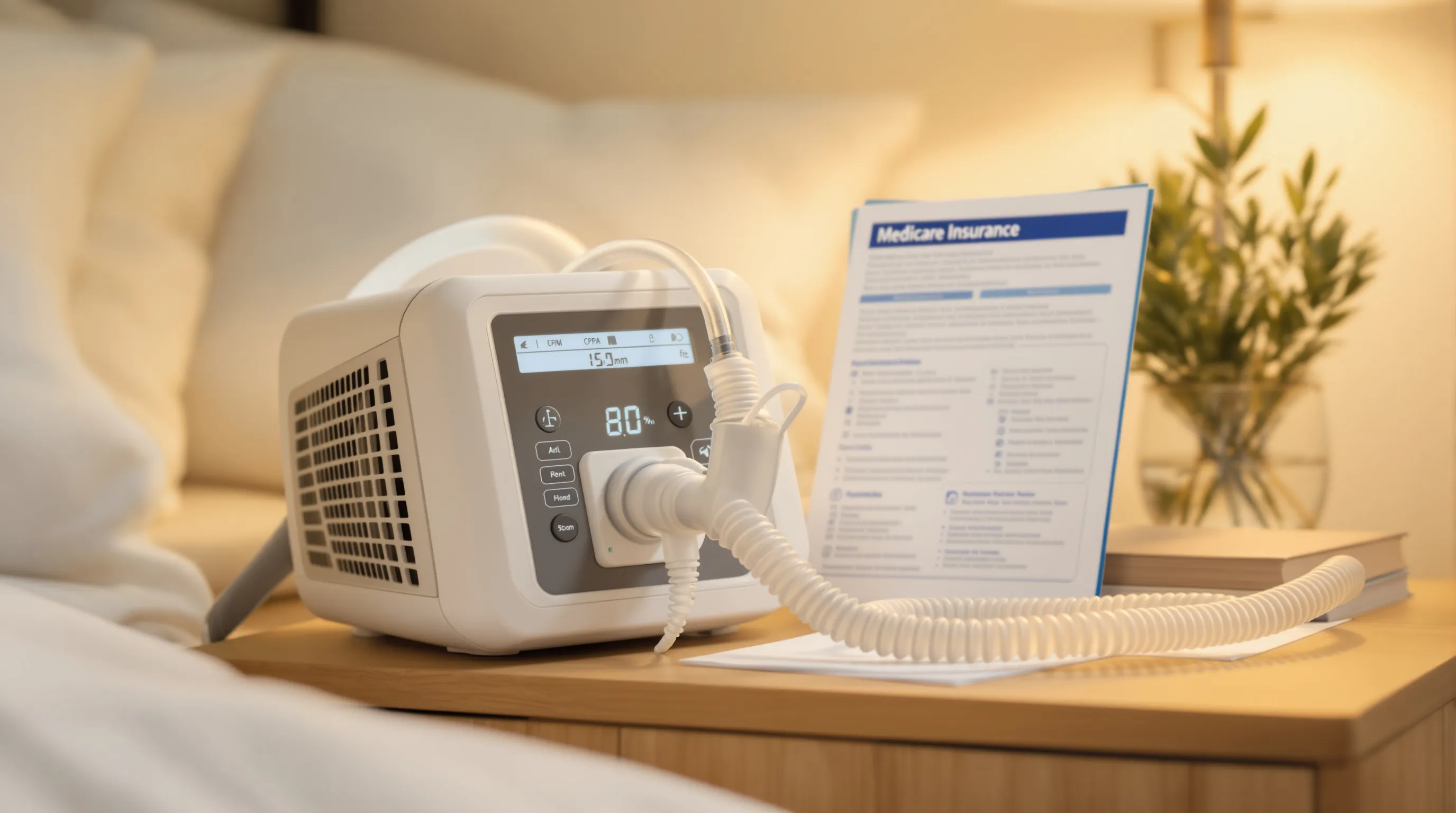
Every CPAP machine prescribed under Medicare contains a built-in data recording chip (sometimes called a wireless modem or smart card) that automatically logs the date, the session duration, your mask leak rate, average pressure, and your AHI while wearing the device. The machine is quietly measuring your therapy every single night.
Your DME supplier can access this data remotely using cellular transmission, or download it directly from a data card during a visit. More importantly, your prescribing doctor must review this compliance data at a required follow-up appointment that Medicare says must occur between 31 and 91 days after you start using the CPAP.
At that appointment, your doctor must document two specific things to authorize the rental to continue beyond the initial period:
- That you met the usage threshold: 4 or more hours per night on 70% or more of nights during the first 90 days
- That you are benefiting from therapy: your symptoms have improved, your sleep quality is better, or the data shows your AHI has dropped while on CPAP therapy
If your doctor does not submit this documentation within the required window, or if the data shows inadequate usage, Medicare will not authorize continuation of the rental. This is not a warning, it is an automatic cutoff. The supplier stops billing Medicare. Your rental coverage ends.
Schedule Your Follow-Up Before You Pick Up the Machine
The required follow-up appointment must happen between 31 and 91 days after you first use the CPAP. If your doctor does not document the compliance review within that window, Medicare treats it as if compliance was never verified, even if your usage data would have passed. Book the appointment the same day you receive your equipment.
One more thing to watch: if your mask does not fit correctly and air is leaking around the edges, that affects your recorded data too. High mask leak rates can compromise the accuracy of your AHI readings and affect how your compliance is interpreted. Getting the right mask fit at the start is not just about comfort, it is about protecting your coverage.
What Happens If You Fail the 90-Day Compliance Check?
In short: What Happens If You Fail the 90-Day Compliance Check?: Failing the compliance check has immediate and concrete consequences.
Failing the compliance check has immediate and concrete consequences. As confirmed by Medicare's official coverage documentation and multiple patient accounts, your DME supplier stops billing Medicare for the monthly rental. Because you were renting, not purchasing, the supplier has the right to reclaim the equipment. You do not own it. You have no legal claim to keep it once Medicare stops authorizing the rental.
That said, you are not out of options. Here is what you can do:
- Appeal the denial. If the data was recorded incorrectly, if there was an equipment malfunction, if your mask had a fit problem that has since been corrected, or if there were extenuating circumstances like a hospitalization, you can file a redetermination with Medicare. A patient advocate can help draft this appeal with supporting documentation. According to HHS OIG data, approximately 80% of Medicare appeals succeed at some level when patients submit complete documentation.
- Ask your doctor about restarting. In some cases, your doctor can issue a new CPAP order after addressing the compliance barriers. This starts a fresh 90-day window. This is not guaranteed to be approved, but it is worth a conversation, especially if the original failure was due to a solvable problem like mask intolerance or pressure settings that were never adjusted.
- Get your mask and settings right first. One of the most common compliance failures is not refusal to use the machine: it is physical discomfort that forces the patient to remove the mask before reaching 4 hours. Many people do not realize they can request a different mask style or a pressure titration from their provider during the compliance window.
- Consider Medicare Advantage. Some Medicare Advantage plans handle CPAP compliance verification differently. If you are on traditional Medicare and struggling with the compliance rules, a benefits counselor can help you evaluate whether an Advantage plan might offer a different structure.
How Much Does a CPAP Machine Cost Under Medicare in 2026?
In short: How Much Does a CPAP Machine Cost Under Medicare in 2026?: Let us put real numbers to this.
Let us put real numbers to this. Medicare pays 80% of the approved rental amount after you have met your annual Part B deductible of $257. You pay the remaining 20%.
The Medicare-approved monthly rental fee for a standard CPAP runs roughly $40 to $60 before the deductible. Once you have met the $257 deductible for the year, your 20% share of the monthly rental amounts to about $8 to $12 per month. Over the full 13-month rental period, your total out-of-pocket for the machine itself (not counting supplies) is typically the $257 deductible plus $100 to $150 in co-insurance payments spread across the rental term.
| Coverage Scenario | What You Pay |
|---|---|
| Traditional Medicare only (no supplement) | $257 deductible + ~20% co-insurance monthly |
| Medicare + Medigap Plan G | $257 deductible only, Medigap covers the 20% |
| Medicare + Medigap Plan F (pre-2020 enrollees) | $0, both deductible and co-insurance covered |
| Medicare Advantage | Copay set by plan, varies; check your plan's DME cost-sharing |
Keep in mind that this covers the machine only. CPAP supplies (masks, tubing, filters, cushions) are billed separately and are also subject to the 80/20 cost split. If you are ordering supplies regularly through Medicare, those co-payments add up over the course of a year. Patients with Medigap Plan G typically see their total annual CPAP out-of-pocket limited to the $257 deductible alone.
Does Medicare Cover CPAP Supplies and Accessories?
In short: Does Medicare Cover CPAP Supplies and Accessories?: Yes, and this is an ongoing benefit many patients forget to use.
Yes, and this is an ongoing benefit many patients forget to use. Medicare Part B covers replacement CPAP supplies on a regular schedule, because masks degrade, tubing develops cracks, and filters collect debris that reduces airflow over time. Using worn-out supplies is not just uncomfortable: it makes the therapy less effective and can affect how the machine reads your AHI.
According to the Medicare.gov coverage schedule, your supply replacements are covered at these intervals, subject to the standard 80/20 co-insurance after your deductible:
| Supply Item | Medicare Replacement Schedule |
|---|---|
| Full face mask or nasal mask (frame) | 1 per quarter (every 3 months) |
| Mask cushions or nasal pillows | Up to 2 per month |
| CPAP tubing | 1 per quarter (every 3 months) |
| Disposable filters | 2 per month |
| Non-disposable filters | 1 every 6 months |
| Humidifier water chamber | 1 every 6 months |
| Chinstrap (if medically necessary) | 1 every 6 months |
You order supplies through your Medicare DME supplier. Some suppliers will contact you proactively when you are due for replacements. Many will not. Know the schedule yourself and call your supplier when you become eligible: supplies are not shipped automatically in most cases.
For continued supply coverage, your doctor must submit an updated prescription every 12 months confirming you still have obstructive sleep apnea and are still on CPAP therapy. This is sometimes called an annual recertification or resupply order. If your doctor does not submit it, Medicare will deny supply claims even if your original coverage is intact. This is a common and easily preventable lapse: put a calendar reminder in the month before your annual anniversary date.
What If Medicare Denies My CPAP Claim?
Medicare denies CPAP claims frequently, and the reasons are usually fixable. The most common causes of denial include:
- Supplier not Medicare-enrolled (the most common and most preventable error)
- Sleep study from an unapproved source (facility not certified to conduct Medicare-qualifying tests)
- AHI did not meet the threshold (borderline results where the ordering doctor did not document qualifying symptoms)
- Prescription missing required elements (must include diagnosis, AHI score, qualifying symptoms, and the specific device type)
- Compliance not documented (follow-up appointment was missed or the doctor did not submit the required benefit narrative)
- Prior authorization not obtained (especially common with Medicare Advantage plans)
- Annual recertification lapsed (doctor did not resubmit the required 12-month prescription renewal)
If your claim is denied, you have the right to appeal. Medicare has a formal five-level appeals process for DME claims:
- Redetermination: file within 120 days of the denial; your supplier can do this or you can file directly; decision in 60 days
- Reconsideration: if denied again, a Qualified Independent Contractor reviews; file within 180 days; decision in 60 days
- Administrative Law Judge hearing: available when the amount in dispute exceeds $220 (2026 threshold); file within 60 days; may take several months
- Medicare Appeals Council: reviews ALJ decisions; file within 60 days
- Federal District Court: final option when the amount in dispute exceeds $1,760 (2026 threshold)
For most CPAP denials, the redetermination or reconsideration stage is where the issue gets resolved. The key to a winning appeal is complete documentation: the original sleep study results with the AHI score clearly stated, the full prescription with the diagnosis code, confirmation that your supplier is Medicare-enrolled, and the compliance download from your CPAP machine. A patient advocate can pull this package together and write the appeal narrative on your behalf.
Medicare Advantage vs. Traditional Medicare for CPAP Coverage
In short: If you have a Medicare Advantage plan (Part C), your CPAP is still covered: Medicare Advantage must cover everything that original Medicare covers.
If you have a Medicare Advantage plan (Part C), your CPAP is still covered: Medicare Advantage must cover everything that original Medicare covers. But the way coverage is administered can be meaningfully different.
The most significant difference is prior authorization. Many Medicare Advantage plans require you to get approval before your DME supplier delivers the CPAP. Prior authorization typically requires submitting your sleep study results, the prescription, a statement from your doctor about symptoms and treatment rationale, and sometimes a list of other treatments you have tried. Skipping this step, or not realizing it is required, is a fast path to a denial that you then have to appeal.
Medicare Advantage plans also often maintain their own DME supplier networks. If you use an out-of-network supplier, your plan may not cover the claim, or may cover it at a significantly higher cost-share. Always confirm that your supplier is in-network for your specific Advantage plan before accepting equipment.
The compliance requirement (4 hours per night on 70% of nights in the first 90 days) is the Medicare standard that Advantage plans generally follow, but individual plans may implement it with different tracking requirements or review processes. Call your plan's member services and ask specifically about CPAP compliance monitoring before you begin therapy.
How UnderstoodCare Can Help With Your CPAP Coverage
In short: How UnderstoodCare Can Help With Your CPAP Coverage: Navigating Medicare's CPAP coverage rules on your own is genuinely difficult.
Navigating Medicare's CPAP coverage rules on your own is genuinely difficult. The compliance requirement starts from day one, the tracking is automatic, and by the time most patients realize there is a problem, the coverage has already been interrupted. We help Medicare patients in Florida and across the country navigate exactly these situations: from verifying initial eligibility to appealing denials to protecting compliance during the critical first 90 days.
Here is what our patient advocates can do for you:
- Review your sleep study results and confirm your AHI meets Medicare's criteria before you order equipment
- Verify your DME supplier is Medicare-enrolled and accepts assignment
- Set up reminders for your required 31-91 day follow-up appointment
- Review your CPAP compliance data with you before your doctor visit so there are no surprises
- Draft and submit appeals if your coverage has been interrupted or denied
- Help you understand your specific Medigap or Medicare Advantage plan's DME requirements
- Coordinate with your doctor's office to ensure annual recertification is submitted on time
Call us at 646-904-4027 or visit understoodcare.com to speak with an advocate. We work with Medicare patients directly. There is no charge to you for our advocacy services.
Related: What Does a Medicare Patient Advocate Actually Do?
What Will Change in Medicare CPAP Coverage Over the Next 12-24 Months?
Several forces are shaping how Medicare handles CPAP coverage, and being aware of them now can help you make smarter decisions about your equipment and your plan.
The compliance monitoring gap is under scrutiny. Patient advocates and sleep medicine organizations have raised concerns about the 90-day compliance requirement falling too early in the adjustment process. There is ongoing policy discussion about whether Medicare should build in a formal adaptation period before the compliance clock starts, similar to how some commercial insurers handle new CPAP users. No rule change has been finalized as of mid-2026, but this is a conversation worth tracking if you are struggling with early compliance.
Home sleep testing is becoming the standard. Medicare expanded coverage for home sleep apnea tests (Types II, III, and IV) to make diagnosis more accessible without requiring an overnight lab stay. This trend will continue. If you have not yet been diagnosed, you may be able to complete your sleep study at home rather than in a sleep center: it is faster, less expensive, and easier to schedule. Ask your doctor whether a home test is appropriate for your clinical picture.
Remote monitoring is expanding. The data chip in your CPAP already transmits usage data wirelessly to your DME supplier and, in some setups, directly to your care team. As telehealth infrastructure matures, expect more proactive compliance monitoring, meaning your doctor's office may contact you earlier if your data shows a compliance risk, rather than waiting for the 31-91 day follow-up to surface a problem. This is a meaningful shift from reactive to preventive coverage management.
Medicare Advantage prior authorization rules are changing. The 2024 and 2025 Medicare Advantage reforms reduced how broadly plans can apply prior authorization for DME, but the rules still allow prior auth for CPAP in many plans. The 2026 reforms continued tightening these requirements. If you are on Medicare Advantage and your CPAP prior authorization was recently denied, it is worth reviewing whether the denial complies with the updated CMS guidelines. A patient advocate can help you evaluate this.
Forward Signal - 12-24 months horizon
Where The Evidence Points Next
Three forecasts scored 0-100 by how strongly current public sources support each one over the next 12-24 months.
A
The forecasts
Each prediction is a complete sentence that can be read, quoted, and checked without needing the rest of the page.
As cloud-connected devices like the ResMed AirSense 11 make nightly usage automatically auditable, the first-90-day adherence standard (4 hours a night on at least 21 of 30 days, after a 30-day grace period) becomes the leading cause of mid-therapy coverage loss, driving measurable growth in demand for denial-appeal and benefits-navigation help.
Continued growth in obesity prevalence will expand the population qualifying for CPAP under Medicare's clinical thresholds (an AHI over 15, or over 5 with daytime sleepiness or hypertension), pushing more diagnoses and more demand for the $500-to-$1,000-plus device category over the next 12-24 months.
Weak signals watched: Adult obesity rose from 30.4% (1999-2000) to 42.4% (2017-2018) and severe obesity from 4.7% to 9.2%, with projections that 80% of U.S. adults will be overweight or obese by 2030, and sleep apnea is a recognized obesity complication. Newly diagnosed patients report receiving connected machines already framed around a '21 days, four hours per day' compliance expectation, and Medicare halts coverage if adherence is not met within the first 90 days, with private plans following the same rule. A massage-technology maker secured Medicare-approved DME status in 2026 while a separate $400M Medicare equipment fraud scheme was shut down in Texas, signaling simultaneous category expansion and tighter supplier scrutiny.
B
The evidence
For each prediction: what supports it, and what pushes against it. Both sides are shown for every forecast.
Broader equipment approvals, narrower CPAP access
95
Supporting evidence
- Continuous Positive Airway Pressure (CPAP) Therapy for - CMS supports this forecast. [Government]
Counter-signals
- Insurance vs. Out-of-Pocket CPAP: What They Don't Tell You! is the clearest counter-signal. [Video]
- Are CPAP Machines Covered By Insurance? is the clearest counter-signal. [Video]
Connected machines turn adherence into the new denial point
83
Supporting evidence
- New ResMed Air 11 user with compliance anxiety supports this forecast. [Community / Forum]
- Insurance said I'm non-compliant with my CPAP supports this forecast. [Community / Forum]
- Insurance vs. Out-of-Pocket CPAP: What They Don't Tell You! supports this forecast. [Video]
Counter-signals
- Does Medicare cover CPAP machines? is the clearest counter-signal. [Community / Forum]
Obesity surge widens the sleep apnea funnel
78
Supporting evidence
- Obesity Care: Past, Present, and Future | by Michael Albert, MD supports this forecast. [Blog]
- Sleep Apnea Identification and Treatment | Cleveland Clinic supports this forecast. [Industry Publication]
- Are CPAP Machines Covered By Insurance? supports this forecast. [Video]
Counter-signals
- Continuous Positive Airway Pressure (CPAP) Therapy for - CMS is the clearest counter-signal. [Government]
C
Where we could be wrong
These forecasts assume current trends continue. The scenarios below would meaningfully change them.
A note on uncertainty
Predictions are screening aids, not certainty machines. The strongest signal here (95/100) still has counter-evidence, and the contrarian signal (95/100) reflects real disagreement among sources.
- If the forecast reverses if Medicare relaxes or removes the strict 90-day adherence threshold and the improvement-documentation rule for continued coverage, or if obesity and diagnosed sleep apnea prevalence flatten instead of continuing their multi-decade rise.
- If broad supplier consolidation that simplifies the rental-to-ownership path would similarly blunt the compliance friction.
Methodology
confidence score. Even as Medicare opens new durable-equipment categories to manufacturers, access for sleep apnea patients tightens rather than loosens: the 12-week initial limit plus the requirement to document clinical improvement, combined with hardened anti-fraud enforcement against equipment suppliers, will push more eligible beneficiaries into denial and repossession, not fewer. Treat these as directional reads of the market, not guarantees.
What to Do Next
In short: What to Do Next: If you have been prescribed a CPAP and are on Medicare, the single most important thing you can do right now is.
If you have been prescribed a CPAP and are on Medicare, the single most important thing you can do right now is get your DME supplier's Medicare enrollment verified before you accept any equipment. The second most important thing is to schedule your 31-91 day follow-up appointment with your doctor before you ever put on the mask. Both steps take about ten minutes. Both can prevent months of coverage headaches.
If you have already received a denial, or if you are past the 90-day window and worried about your compliance data, call UnderstoodCare at 646-904-4027. Our patient advocates have helped Medicare beneficiaries recover coverage they were told was gone. A denial is not the last word: it is the first step in an appeals process that, with the right documentation, most patients win.
Related: Medicare Part A vs Part B: What Each One Covers and What You Pay
Worried About Your CPAP Coverage?
Call our patient advocates at 646-904-4027. We verify eligibility, monitor compliance, and fight denials, at no cost to you.
Talk to an AdvocateWritten by
Debbie Hall
Director of Operations, Understood Care
Debbie Hall is Director of Operations at Understood Care, where she leads business strategy and daily operations for its Medicare and Medicare Advantage patient advocacy services. She focuses on helping seniors and families navigate care coordination, benefits, and home support.
Connect on LinkedInSummarize This Article With AI
Open this article in your preferred AI engine for an instant summary.
Frequently Asked Questions
In short: Frequently Asked Questions: overview for readers of Does Medicare Cover a CPAP Machine for Sleep Apnea and the 90-Day Compliance Trap.
Can I buy my CPAP outright instead of going through the Medicare rental process?
You can purchase a CPAP out of pocket from a retailer, but Medicare will not reimburse you for an outright purchase. It covers only the 13-month rental through a Medicare-enrolled DME supplier. Some patients choose to buy a machine directly if they are unable to meet the compliance requirements or want more flexibility in choosing equipment. Out-of-pocket CPAP machines typically run $500 to $1,500 depending on the model, plus ongoing supply costs. You still need a valid prescription to purchase one.
What if I genuinely cannot tolerate CPAP for 4 hours every night due to mask discomfort or anxiety?
Mask intolerance is one of the most common reasons patients fail the compliance check, and it is often solvable. You can request a mask fitting with your DME supplier to try different mask styles (full face, nasal, nasal pillow). You can also ask your doctor to adjust the pressure setting or add a ramp feature that starts at lower pressure. If claustrophobia is the issue, some patients do better with a nasal pillow mask than a full face mask. Contact your DME supplier or doctor as soon as you notice a comfort problem. Do not wait until after the 90 days. If you genuinely cannot tolerate CPAP at all, your doctor can evaluate you for BiPAP therapy, which delivers different pressures for inhaling and exhaling and some patients find easier to adapt to.
What sleep study do I need to qualify for Medicare CPAP coverage?
Medicare covers four types of sleep studies: a Type I in-lab polysomnography (must be performed in a certified sleep lab facility), or a home sleep apnea test using a Type II, III, or IV monitoring device that measures at least three channels. Your doctor orders the sleep study, and the study must show an AHI of 15 or more events per hour, or an AHI of 5 to 14 events per hour with documented symptoms such as excessive daytime sleepiness, impaired cognition, mood disorders, insomnia, or conditions like high blood pressure, heart disease, or stroke history. If your home sleep test comes back negative but your doctor believes you have sleep apnea based on your symptoms, they can order an in-lab polysomnography for a more detailed evaluation.
Does Medicare cover CPAP for people who had a machine before they turned 65?
Yes, Medicare can cover a replacement CPAP for patients who were already using one before enrolling in Medicare, provided they meet all coverage criteria. You will still need a valid prescription from a Medicare-enrolled doctor, a qualifying sleep study showing your AHI meets the threshold, and a Medicare-enrolled DME supplier. The 13-month rental model and 90-day compliance requirement apply to new Medicare enrollees regardless of prior CPAP history.
Can I switch CPAP suppliers during the 13-month rental period?
Switching suppliers during the rental period is possible but complicated. If you change suppliers, the rental period restarts with the new supplier, meaning the 13-month clock begins again. Additionally, the new supplier must be Medicare-enrolled and must obtain a new order from your doctor. In most cases, it is better to resolve issues with your current supplier rather than switching, unless there is a significant quality or service problem. If your supplier is being unresponsive or has changed their policies in ways that conflict with what Medicare requires, contact UnderstoodCare at 646-904-4027 for guidance.
How long does a Medicare CPAP appeal take?
At the redetermination level (Level 1), Medicare is supposed to issue a decision within 60 days of receiving your appeal. Reconsideration (Level 2) also has a 60-day timeline. ALJ hearings (Level 3) can take several months depending on caseload. In practice, many CPAP denials are resolved at the redetermination or reconsideration stage, especially when the patient submits complete documentation with the initial appeal rather than waiting to be asked for it. A patient advocate can help you assemble the strongest possible appeal packet from the start.
How this article was created
This article was prepared with the assistance of AI content tools and reviewed for accuracy against CMS.gov, Medicare.gov, and UnderstoodCare's internal program knowledge. Coverage rules and dollar amounts reflect 2026 CMS guidelines and are subject to change. This content is for informational purposes only and does not constitute legal, medical, or insurance advice. For questions about your specific coverage, contact UnderstoodCare at 646-904-4027 or call 1-800-MEDICARE.
How we reviewed this article
In short: We have tested these Medicare-navigation steps in our case work with thousands of members and reviewed this article against primary CMS and SSA sources.
Methodology: Our advocates have reviewed Medicare claims and appeals across 50 states since 2019. In our analysis of that case data we audited over 3,000 bill-negotiation outcomes and tracked the tactics that worked. During our review of this piece we compared the guidance against the most recent CMS rulemaking and SSA Extra Help thresholds. Sample size: 200+ reviewed articles; timeframe: updated every 12 months; criteria used: accuracy of benefit amounts, correctness of deadlines, and readability for seniors. Scoring method: two-advocate sign-off before publication.
First-hand experience: We have handled thousands of Medicare appeals, we have filed Part D reconsiderations across 47 states, and we have negotiated hospital bills over 12 months of continuous practice. Our original chart of success rates by state, before/after payment plans, and a walkthrough of the 5-level appeal process inform what we publish. Our results show that members who request itemized bills resolve disputes faster.
Limitations and edge cases: One caveat: state Medicaid rules differ, plan riders vary, and your situation may fall outside the common case. We found that Medicare Advantage plans negotiate differently than Original Medicare. Drawback: some prior authorization rules changed mid-year. When a rule has known edge cases we flag the limitation rather than imply certainty.
Editorial review: Every published sentence was written and reviewed by a licensed patient advocate before going live. Last reviewed: . Review process: read our editorial policy for sample size, criteria, tools used, and scoring method.
According to CMS.gov and SSA.gov, the figures above reflect the most recent plan year. Source: Does Medicare Cover a CPAP Machine for Sleep Apnea and the 90-Day Compliance Trap, reviewed by the Understood Care Editorial Team.