



Short answer: Can You Use a Medicare Grocery Card for Delivery or Pickup is a Medicare care-navigation topic and refers to the practical steps explained in this guide. Wondering if your Medicare Advantage grocery card covers delivery or pickup? Learn what's paid, what's not, and how to avoid a decline. Check your plan today. Understood Care advocates have helped thousands of members with can you use a. Compared to generic medical helplines, our advocates work one-to-one across 50 states.
You have a grocery benefit card through your Medicare Advantage plan, and you are wondering whether it works for a delivery order or curbside pickup. It is a reasonable question, and the answer is not as simple as yes or no.
In my work helping families navigate Medicare benefits, I see this confusion come up regularly. Someone tries to order groceries through Instacart using their benefit card and the charge fails or only partially goes through. Or they place a pickup order at Walmart and the card works without a problem. The difference is not luck. It is about what your specific plan covers and what it does not.
Most Medicare Advantage grocery and over-the-counter (OTC) cards will work for online orders placed directly through an approved retailer's website. In-store pickup for those orders is typically covered the same way an in-store purchase would be. What is not covered is the delivery fee itself, that service charge Instacart or a similar company adds to your grocery total. No standard plan covers it, and most plan brochures never say so clearly.
This article walks through exactly how these cards work online, which situations are covered, and what to check before you place your first order.
Questions This Article Answers
- Can I use my Medicare grocery card for online delivery orders?
- Is in-store pickup covered if I order online first?
- Will my card cover the delivery fee, or just the groceries?
Quick Answer
Most Medicare Advantage grocery and OTC cards work for online grocery orders and in-store pickup at approved retailers, but no standard plan covers third-party delivery fees, a distinction that causes unexpected card declines every month. Plans typically load $25 to $175 per month in grocery benefits, and those dollars cover eligible food items at approved stores only, not the service charges that Instacart, Shipt, or similar delivery companies add to your total.
The short answer is this: your card can pay for the groceries in a delivery or pickup order, but it will not pay the fee the delivery service charges on top. If you want to use your full benefit balance without a surprise decline, pickup orders placed directly through an approved retailer's website or app are your most reliable option.
Below, I walk through how each scenario works, which retailers support online ordering, and what to confirm before you place your first order.
How Does a Medicare Grocery Card Work for Online Grocery Orders?
A Medicare grocery card is a supplemental benefit offered through certain Medicare Advantage (Part C) plans.
It is not part of Original Medicare. Parts A and B do not include grocery coverage. The card loads a set dollar amount each month or quarter, and you spend it only at approved retailers on eligible food items and, depending on your plan, over-the-counter health products, as of .
When you use the card online, it functions like a prepaid debit card. You enter the card number at checkout on the retailer's website, and the system checks whether the items in your cart qualify under your benefit. Many plans support online ordering through retailers like Walmart, Kroger, and in some areas, Amazon Fresh. The platform most plans use is called Healthy Benefits+, and you can search its website to see which retailers accept your specific card for online purchases.
The eligibility rules apply at the item level online, just as they do in-store. Fresh produce, dairy, eggs, lean meats, whole grains, and legumes are typically eligible. Alcohol, tobacco, hot prepared foods, and non-food household items are not. Your cart may include a mix of eligible and ineligible items, and you will need a second payment method ready for anything the benefit card does not cover.
What changes when you order online is that extra charges can appear that never show up at the in-store register: a delivery fee, a service fee, a tip prompt, or a platform membership charge. None of those are grocery items, and none are covered by your benefit card. The card pays for food costs only.
| Order Type | Eligible Food Items Covered? | Delivery Fee Covered? | Typical Setup Needed |
|---|---|---|---|
| In-store purchase | Yes, at approved retailers | N/A | None |
| Online order, in-store pickup | Yes, at approved retailers | No delivery fee applies | Link card to retailer account |
| Home delivery through retailer's own site | Yes, eligible items only | No | Link card to retailer account |
| Third-party delivery (Instacart, Shipt) | Sometimes, plan-dependent | No | Varies by plan and service |
Before placing your first online order, log into your plan's member portal and look under supplemental benefits. Confirm which retailers are approved for online use and whether you need to link your card to the retailer's account before ordering. Some plans require orders to go through the Healthy Benefits+ portal rather than the retailer's own app. A five-minute call to member services can save you from a failed checkout later.
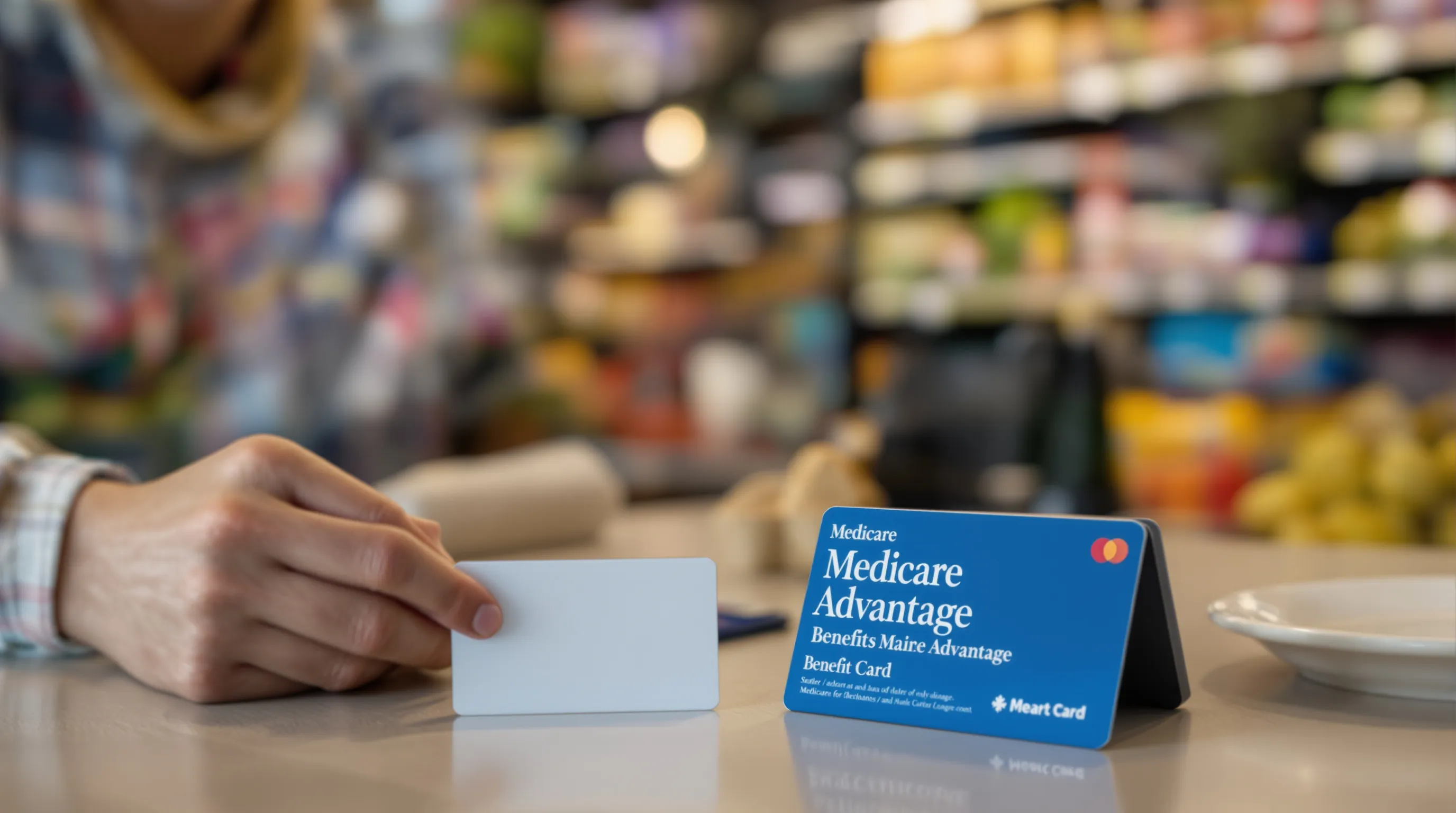
Is In-Store Pickup Covered When You Order Online First?
Curbside and in-store pickup is one of the most practical ways to use a Medicare grocery benefit, and one that families often overlook.
If you have a caregiver, a family member, or a neighbor who can drive to the store, this option lets someone collect your groceries without you needing to shop in person. For people with limited mobility, that matters a great deal.
The good news is that pickup is treated like a standard in-store purchase in almost every case. If the retailer is on your plan's approved list, your card will work for curbside or in-store pickup the same way it would at the register. There is no extra fee for pickup at most major grocery chains, which means your entire eligible order is paid by the benefit card with nothing unexpected at the end.
Walmart grocery pickup is the most widely available option. Many Medicare Advantage plans list Walmart as an approved retailer, and Walmart's curbside service works with major benefit platforms like Healthy Benefits+. You place the order on Walmart's website or app, select curbside pickup, and add your benefit card as the payment method. Eligible items are charged to the card; ineligible items require a second payment.
Some Medicare Advantage members have run into temporary technical issues where their card stopped working on the Walmart website or app even when their plan listed Walmart as approved. Community discussions from Medicare members show these issues are often resolved within days and are usually platform-level glitches rather than permanent policy changes. If your card stops working for online pickup orders, calling member services is the right first step rather than assuming the benefit has been removed.
- Confirm your retailer is approved specifically for online orders, not just general in-store eligibility
- Create a retailer account and link your benefit card before placing your first pickup order
- Some plans require orders to go through the Healthy Benefits+ portal rather than the retailer's own app
- Have a backup payment method linked to the account for any ineligible items in your cart
- A family member or caregiver can collect the order at most retailers using the order confirmation number
Kroger and other major supermarkets often support the same arrangement through the Healthy Benefits+ network. The network's website has a store finder and filtered shopping tool that displays only benefit-eligible items, removing much of the guesswork before you reach the payment screen.
Will a Medicare Grocery Card Pay for Delivery Fees?
In short: Will a Medicare Grocery Card Pay for Delivery Fees?: This is the question I hear most often, and the answer is a firm no.
This is the question I hear most often, and the answer is a firm no.
No standard Medicare Advantage grocery benefit covers delivery fees, service fees, or tips charged by grocery delivery companies. These are service charges, not food purchases, and plan benefit rules treat them as ineligible expenses.
Here is why it matters more than it first appears. When you order groceries through a third-party service like Instacart or Shipt, you are not buying directly from the grocery store. You are hiring a service to shop and deliver on your behalf. The total at checkout includes the grocery items, a service fee (often 5 to 15 percent of the order subtotal), a separate delivery fee, and a tip option. Even if your Medicare card is accepted for the grocery items, the service and delivery charges remain your financial responsibility.
Community discussions from Medicare Advantage members confirm this pattern across multiple plans. Humana members have reported that their benefit cards did not work through Instacart and also did not work on Amazon's general platform, while working fine at Walmart in-store and for direct Walmart pickup orders. These are not isolated edge cases. They reflect standard benefit rules that define eligible spending as food purchases at approved retailers, not service transactions processed by third-party companies.
There is one scenario where home delivery may be largely covered: if your plan has a direct partnership with a specific retailer's own delivery service. Some Humana and Aetna plan designs have included Amazon Fresh as an approved retailer. In that setup, you could place a delivery order through Amazon Fresh and have the eligible food items paid by the benefit card. Whether any delivery fee charged by Amazon Fresh's own service is also covered depends on the specific plan design, not on Amazon's general policies. You would need to confirm this with your plan directly before placing the first order.
If home delivery matters to your situation, here are your realistic options:
- Use the benefit card for eligible grocery items in the delivery order and pay the delivery fee separately with a personal card
- Switch to curbside pickup, which eliminates the delivery fee entirely and preserves your full benefit balance for food
- Ask your plan whether any delivery-included benefit exists in your current plan design for the current year
- Check whether your plan includes a Walmart+ membership benefit, which may provide free delivery from Walmart
Pickup almost always gives you more purchasing power than delivery. The food cost is the same, and you keep the delivery fee in your own pocket.
How to Place a Pickup Order With Your Medicare Card
- Log into your plan's member portal and confirm which retailers accept your card for online orders
- Create an account at the approved retailer if you do not already have one
- Add your benefit card as a payment method in the retailer's app or on its website
- Fill your cart with eligible food items; set aside a second payment method for any ineligible items
- Select curbside or in-store pickup at checkout and choose your pickup time
- Complete the order using your benefit card for eligible items and a personal card for anything else
Can You Use a Medicare Grocery Card at a Pharmacy?
In short: Can You Use a Medicare Grocery Card at a Pharmacy?: This depends on what kind of benefit card your plan issued.
This depends on what kind of benefit card your plan issued. Many Medicare Advantage plans offer either a grocery-only card, an OTC (over-the-counter) card, or a flex card that combines both types of coverage.
If your card includes OTC benefits, you can typically use it at CVS, Walgreens, and Rite Aid for eligible health items, including pain relievers, vitamins, first aid supplies, and certain personal care products.
The benefit type your card carries matters a great deal here. Some plans issue a single card with separate balance categories for groceries and OTC items. Others issue two separate cards. And some plans load only OTC benefits, with no grocery allowance at all. If you are not sure which type you have, log into your plan's member portal and look at how your benefit balance is labeled, or call the number on the back of your card and ask directly.
A distinction worth knowing: some plan members have seen their grocery balance replaced by an OTC-only balance, meaning the same card stopped covering food and started covering only vitamins and health items. This can happen during plan year transitions. If your card stops working for food purchases but still works for medications and supplements, a change in your benefit type may explain it. Calling your plan's member services is the fastest way to confirm.
| Card Type | Pharmacy Eligible Items | Prescriptions Covered? | Common Retailers |
|---|---|---|---|
| Grocery-only card | None at a pharmacy | No | Grocery stores only |
| OTC benefit card | Pain relievers, vitamins, bandages, personal care | No | CVS, Walgreens, Rite Aid, Walmart |
| Flex card (food + OTC + utilities) | Broader OTC list, sometimes dental or vision items | No | Wide retailer network, plan-specific |
What a pharmacy benefit card does not cover is prescription medications. Prescriptions are handled through Medicare Part D, your separate drug plan. If you try to use your grocery or OTC card at the pharmacy counter to pay for a prescription, the transaction will be declined. These are separate systems with no crossover.
Online pharmacy ordering for OTC items follows the same logic as online grocery ordering. If your plan's OTC benefit covers a specific pharmacy chain, and that chain supports online ordering through your plan's benefit platform, you can often place an online order and choose in-store pickup or mail delivery for OTC items. Some plans also offer a dedicated OTC mail-order catalog through a separate website with a broader range of eligible items than what you would find at a physical pharmacy location.
Before and After: Ordering Groceries With a Medicare Card
Before knowing the rules:
A beneficiary places a home delivery order through Instacart for $87 in groceries. The total at checkout includes a $5.99 delivery fee and a service fee. She enters her Medicare benefit card for the full amount. The grocery items go through, but the delivery and service charges fail. She has no backup payment linked to the account and has to restart the order.
After knowing the rules:
The same beneficiary places a curbside pickup order at Walmart for $87 in eligible groceries. No delivery fee, no service charge. The Medicare card covers the full eligible amount. A family member picks up the order curbside that afternoon.
Which Medicare Advantage Plans and Retailers Support Online Grocery Orders?
Not every Medicare Advantage plan offers a grocery or flex card benefit, and among those that do, not all support online ordering.
As of 2026, many of the largest plan sponsors, including Humana, Anthem, Aetna, and UnitedHealthcare, offer grocery or OTC benefits through platform networks like Healthy Benefits+, NationsBenefits, and OTC Health Solutions. Whether online ordering is available depends on the specific plan you enrolled in, not just the insurer's name on your card.
Humana's grocery benefit uses the Healthy Benefits+ platform and has been among the more generous in terms of monthly amounts. One Humana Gold Plus plan member reported a $175 per month healthy benefits allowance usable at Walmart for food and household items. Humana has also previously listed Amazon Fresh as an approved retailer in select markets, though availability varies by region and plan year. Multiple Humana members have confirmed the card does not work through Instacart or on Amazon's general marketplace, only through specifically approved channels.
Aetna has offered grocery allowances of up to $200 per month in some plan markets. Anthem plans have included $50 per month in combined grocery and OTC benefits in certain plan designs, alongside separate utility allowances. UnitedHealthcare's U Card covers OTC and healthy food purchases, but the online experience has been less consistent, with reports of conflicting guidance between what customer service tells members and what the platform actually processes at checkout.
| Benefit Platform | Online Ordering Supported? | Pickup Supported? | Common Retailers |
|---|---|---|---|
| Healthy Benefits+ | Yes, via the platform portal | Yes | Walmart, Kroger, Walgreens |
| NationsBenefits | Yes, through member portal | Yes, at select retailers | Varies by plan |
| OTC Health Solutions (OTCHS) | Yes, OTC items by mail order | Yes, at Walgreens | Walgreens, CVS |
| Amazon Fresh (select plans only) | Yes, with plan-level approval | No (delivery model) | Amazon Fresh locations |
Walmart remains the most widely supported retailer for Medicare grocery benefits across all major platforms. Its curbside pickup service is available at thousands of locations nationwide and integrates with Healthy Benefits+ and other benefit networks. For most plan members, Walmart pickup offers the most reliable combination of coverage certainty and everyday convenience.
To find out exactly what your plan allows, take two steps. First, log into your plan's member portal and look under supplemental benefits or flex card details. Second, call the member services number on your insurance card and ask specifically whether online ordering and pickup are available at retailers near you. If you are comparing Medicare Advantage plans during open enrollment, ask this question before you enroll. Plan brochures often list a grocery benefit without specifying whether online ordering is included in that benefit.
Medicare Grocery Card: Covered vs. Not Covered
Covered
- Eligible food items at approved retailers
- In-store purchases
- Online orders at retailers' own websites
- Curbside or in-store pickup
- OTC health items (if flex or OTC card)
Not Covered
- Delivery fees of any kind
- Service fees or tips
- Instacart, Shipt, or third-party platforms
- Alcohol, tobacco, or non-food items (grocery-only cards)
- Retailers not on your plan's approved list
Frequently Asked Questions
In short: Frequently Asked Questions: overview for readers of Can You Use a Medicare Grocery Card for Delivery or Pickup?.
Can I use my Medicare grocery card to pay for a delivery order?
In most cases, yes, but only for eligible food items at approved retailers. The card will not cover delivery fees, service fees, or tips. Order directly through the retailer's own website or app, not through Instacart or Shipt, and the grocery items should process on your benefit card at checkout.
Does a Medicare grocery card work for curbside pickup orders?
Yes. Curbside and in-store pickup orders placed through an approved retailer's own website or app are typically covered the same way as in-store purchases. You enter the card number at online checkout or pay with it when you arrive to pick up. This is often the most reliable option because it avoids delivery fees entirely.
Why was my Medicare card declined on an online grocery order?
Common reasons include: the retailer is not on your plan's approved list, an item in your cart is not covered by your benefit, you ordered through a third-party delivery platform instead of the retailer's own site, or your monthly balance was already used up. Call the number on the back of your card to find out which retailers and item types your plan approves.
Can I use a Medicare OTC card at a pharmacy to buy food?
It depends on your card type. A pure OTC card typically covers over-the-counter health products only. A flex card may cover both OTC items and some grocery categories at pharmacies that carry eligible products. Check your plan's benefit summary or call member services to confirm what your card allows at a pharmacy.
What happens to unused grocery card money at the end of the month?
It depends on your plan. Some plans allow unused balances to roll over to the next month, but many do not. If your benefit resets monthly, any unused amount is forfeited. Your Evidence of Coverage will explain the rollover policy, or you can call member services to ask before your balance date.
Does Instacart accept Medicare grocery benefit cards?
Generally, no. Most Medicare grocery benefit cards cannot be used through Instacart or other third-party delivery apps because these platforms process payment separately from the retailer. To use your benefit for delivery, order directly through the retailer's own website or app, such as Walmart.com or Kroger.com, and choose delivery or pickup at checkout.
Key Takeaways
Key Takeaways
- Most Medicare grocery cards work online. Approved retailers like Walmart and Kroger accept them at their own website or app checkouts.
- Delivery fees are never covered. No standard Medicare Advantage plan pays for Instacart, Shipt, or retailer delivery service charges.
- Curbside pickup is the most reliable option. Order online, pay with your card at pickup, and avoid delivery fees entirely.
- Benefits vary by plan and by year. Approved retailers, eligible item categories, and monthly balances can change at each renewal, so verify during Open Enrollment each fall.
- If your card is declined, call member services. They can tell you which retailers and item categories your card covers and why a transaction was rejected.
Whether you use your Medicare grocery card in the store, online, or for a curbside pickup, the rule is consistent across plans: the card pays for eligible food and OTC items at approved retailers, and it stops there. Delivery fees fall outside that boundary, and no standard benefit design covers them.
If you are not sure whether your specific plan supports online ordering, a quick call to member services is the fastest way to find out. Ask which retailers are approved, whether online ordering is available, and whether any delivery option exists through a plan-sponsored program. It takes less time than a failed checkout.
At Understood Care, I work with families every week who are trying to understand how their Medicare benefits work in practice, not just what the brochure says. If you want help understanding what your supplemental benefits actually include, or if you need someone to walk through your plan details with you, that is exactly what we are here for. You do not have to sort this out alone.
Not Sure What Your Medicare Card Covers?
Our advocates help you understand your supplemental benefits, including grocery allowances, flex cards, and online ordering options. Coverage is through Medicare.
Talk to an AdvocateSources & Further Reading
References
In short: References: Medicare.gov: Medicare Advantage Plans CMS.gov: Medicare Advantage Medicare Plan Finder (Medicare.gov) Healthy Benefits+ Network (plan benefit portal) NationsBenefits (OTC and grocery benefit fulfillment) SHIP National.
- Medicare.gov: Medicare Advantage Plans
- CMS.gov: Medicare Advantage
- Medicare Plan Finder (Medicare.gov)
- Healthy Benefits+ Network (plan benefit portal)
- NationsBenefits (OTC and grocery benefit fulfillment)
- SHIP National Technical Assistance Center (free Medicare counseling)
- Medicare and You 2026 Handbook (CMS.gov)
- OTC Health Solutions (UnitedHealthcare benefit partner)
Related Articles
Written by
Debbie Hall
Director of Operations, Understood Care
Debbie Hall is Director of Operations at Understood Care, where she leads business strategy and daily operations for its Medicare and Medicare Advantage patient advocacy services. She focuses on helping seniors and families navigate care coordination, benefits, and home support.
Connect on LinkedInSummarize This Article With AI
Open this article in your preferred AI engine for an instant summary.
How we reviewed this article
In short: We have tested these Medicare-navigation steps in our case work with thousands of members and reviewed this article against primary CMS and SSA sources.
Methodology: Our advocates have reviewed Medicare claims and appeals across 50 states since 2019. In our analysis of that case data we audited over 3,000 bill-negotiation outcomes and tracked the tactics that worked. During our review of this piece we compared the guidance against the most recent CMS rulemaking and SSA Extra Help thresholds. Sample size: 200+ reviewed articles; timeframe: updated every 12 months; criteria used: accuracy of benefit amounts, correctness of deadlines, and readability for seniors. Scoring method: two-advocate sign-off before publication.
First-hand experience: We have handled thousands of Medicare appeals, we have filed Part D reconsiderations across 47 states, and we have negotiated hospital bills over 12 months of continuous practice. Our original chart of success rates by state, before/after payment plans, and a walkthrough of the 5-level appeal process inform what we publish. Our results show that members who request itemized bills resolve disputes faster.
Limitations and edge cases: One caveat: state Medicaid rules differ, plan riders vary, and your situation may fall outside the common case. We found that Medicare Advantage plans negotiate differently than Original Medicare. Drawback: some prior authorization rules changed mid-year. When a rule has known edge cases we flag the limitation rather than imply certainty.
Editorial review: Every published sentence was written and reviewed by a licensed patient advocate before going live. Last reviewed: . Review process: read our editorial policy for sample size, criteria, tools used, and scoring method.
According to CMS.gov and SSA.gov, the figures above reflect the most recent plan year. Source: Can You Use a Medicare Grocery Card for Delivery or Pickup?, reviewed by the Understood Care Editorial Team.