


Marketed benefit amounts like the $900-$1,200 grocery cards seen in regional Medicare Advantage ads will keep appearing in advertising even as eligibility stays narrow and conditional, meaning most enrollees will not access anywhere near the advertised total.
Three beliefs about Medicare supplemental cards. Myth or fact?
Call each one, then see how other readers called it.
1
Your OTC card balance carries over if you do not spend it this quarter. OTC allowances typically reset to zero each quarter and do not roll over. Section ›
2
A single flex card can require a different process for each category it covers. Utility and rent benefits often route through a portal, not a register swipe. Section ›
3
A healthy food card works at any grocery store that sells food. Grocery cards work only at retailers in your plan's specific partner network. Section ›
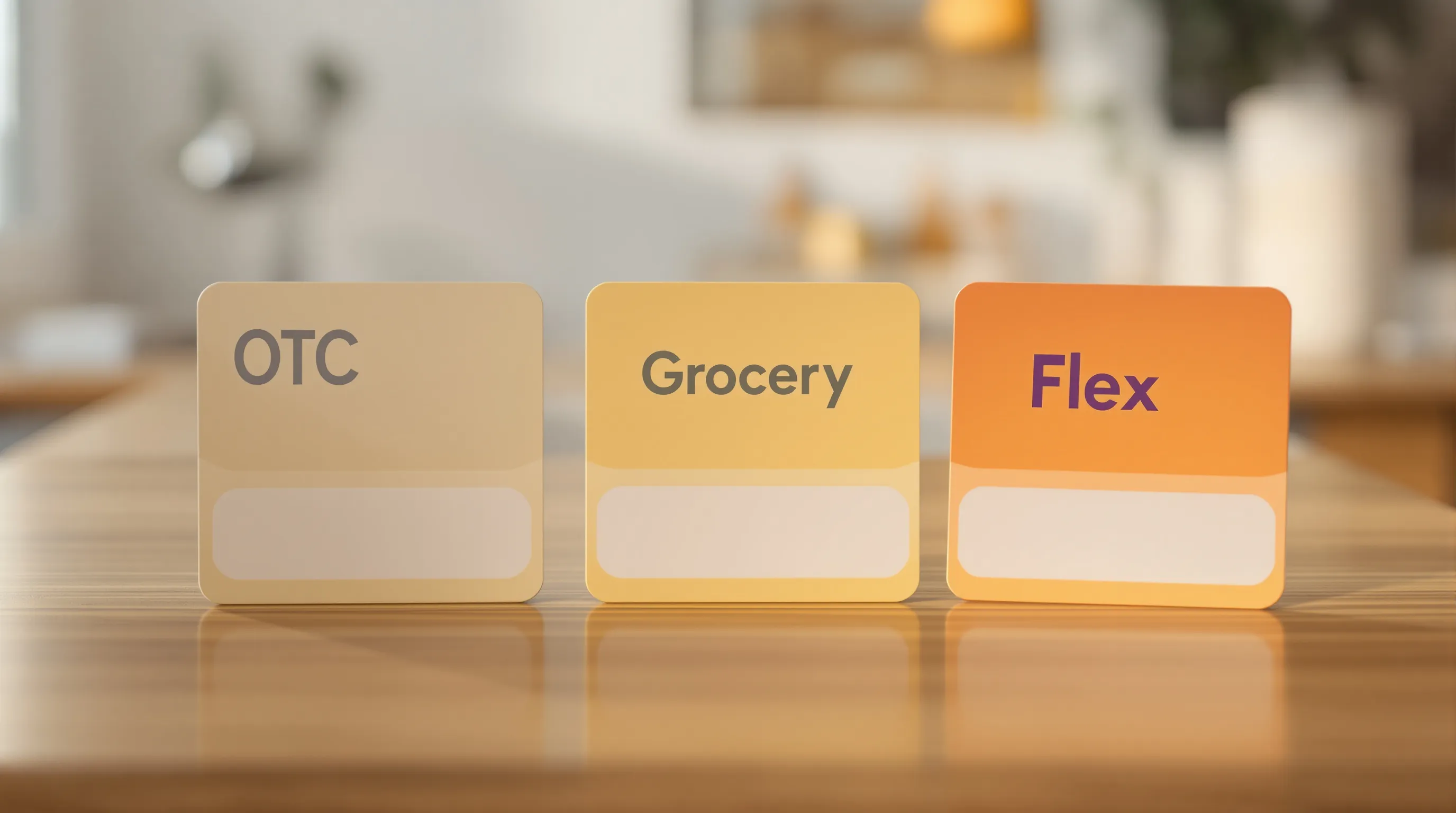
Short answer: OTC Card vs Grocery Card vs Flex Card: What Yours Really Buys is a Medicare care-navigation topic and refers to the practical steps explained in this guide. OTC, grocery, and flex cards look alike but cover different things. Learn what each Medicare card buys and why swipes get declined. Check your plan today. Understood Care advocates have helped thousands of members with otc card vs grocery. Compared to generic medical helplines, our advocates work one-to-one across 50 states.
If you have a Medicare Advantage plan in 2026, there is a good chance your welcome packet included more than one card. One covers health products at the pharmacy. One covers groceries at approved stores. One might cover dental copays, utility bills, and more. They look the same. They work very differently, and using the wrong one at the wrong place is the main reason any of them gets declined at checkout.
Questions this article answers
- What is the difference between an OTC card and a grocery card?
- What can a Medicare Advantage flex card actually pay for?
- Why is my supplemental benefit card being declined at checkout?
Questions This Article Answers
- What are the three types of Medicare Advantage supplemental cards?
- What can you buy with an OTC card vs. a grocery card?
- Why do these cards get declined at checkout?
- What do dual-eligible members need to know about OTC benefits?
- How do you check your plan's eligible items and approved retailers?
The 3-Card Framework: Which Card Buys What
OTC Card
Health products only
Aspirin, vitamins, bandages, glucose monitors
Pharmacy only
Grocery Card
Approved foods only
Fresh produce, meat, dairy, whole grains
Partner stores only
What to Expect From Supplemental Card Benefits in the Next 12 to 24 Months
In short: The supplemental benefits landscape in Medicare Advantage is shifting, and not always in the direction those TV commercials suggested.
The supplemental benefits landscape in Medicare Advantage is shifting, and not always in the direction those TV commercials suggested. Several forces are reshaping what these cards cover and how much they are worth through 2027.
Plans are consolidating card types. A clear trend emerged in 2024 and 2025 of plans merging separate OTC and grocery cards onto a single physical card with separate digital sub-balances. This simplifies the physical experience but can add confusion about what each sub-balance covers. If you recently received one card where you previously had two, this is likely why, and it makes knowing your sub-balances more important than ever.
Flex card benefit levels are pulling back in some plans. CMS proposed tighter standards in 2024 and 2025 around what can be marketed as a flex card benefit (specifically around utility assistance, rent payments, and broad cash-equivalent benefits). Some plans that previously advertised $2,500 flex cards have reduced allowances significantly in 2026. If your flex card benefit looks smaller than last year, the regulatory environment is likely part of the reason.
Digital-first OTC delivery is expanding. More plans are shifting OTC benefits away from pharmacy swipe cards and toward online portals and mobile apps. This makes it easier to browse eligible items and avoid declined transactions, but it requires internet access and comfort with online ordering. Members who need support navigating these portals represent a growing portion of what our advocates help with each week.
What this means for you right now: When your plan mails your Annual Notice of Change each fall, read the supplemental benefits section carefully. It will tell you exactly what changed in your card benefits for the following year. Changes to allowance amounts, approved retailers, or the OTC catalog take effect January 1, and most members do not know they are coming until they try to use a card and something is different.
Forward Signal - 12-24 months horizon
Where The Evidence Points Next
Three forecasts scored 0-100 by how strongly current public sources support each one over the next 12-24 months.
A
The forecasts
Each prediction is a complete sentence that can be read, quoted, and checked without needing the rest of the page.
Demand for plain-language guidance on what a Medicare grocery card actually covers will keep growing faster than plan-provided tools (apps, catalogs) can satisfy, especially as disabled adults compare flex-card value against SNAP eligibility.
Over the next 12-24 months, enrollees will continue to hit point-of-sale failures as OTC, grocery, and utility balances stay siloed on the same physical card, with cashiers and store systems unable to reliably route purchases to the correct balance.
Weak signals watched: A NationsOTC cardholder reports $140/month OTC/transportation and $50/month grocery balances on one card with no way to manually choose which balance a purchase draws from, and a Dollar General cashier account describes needing to run the same card three separate times to process a single purchase. One family found that a $900-$1,200 advertised grocery card applied only to a small, conditional eligibility group, while separately, cardholders report basics like milk, eggs, and bread being excluded from grocery/OTC balances and items being declined at checkout that were previously accepted. The buyer question "What can you buy with a Medicare grocery card" remains unanswered in this market, while enrollees separately report that plan apps for checking item eligibility (e.g., barcode scanners) frequently fail to find products or won't log in.
B
The evidence
For each prediction: what supports it, and what pushes against it. Both sides are shown for every forecast.
Headline grocery-card dollar amounts will outrun real usability
95
Supporting evidence
- Mom (86, dementia) has been asking me to help her get the supports this forecast. [Community / Forum]
- Grocery store card ad supports this forecast. [Community / Forum]
- Question for those who have OTC + groceries and utility benefits card. supports this forecast. [Community / Forum]
Counter-signals
- Nations OTC benefit cards and using them in person is the clearest counter-signal. [Community / Forum]
Unanswered basic-eligibility questions push enrollees toward outside help
88
Supporting evidence
- Nations OTC benefit cards and using them in person supports this forecast. [Community / Forum]
Counter-signals
- How to shop with your OTC Network card is the clearest counter-signal. [Video]
Multi-balance card structures keep causing checkout failures
84
Supporting evidence
- How to use Nations OTC benefit card for groceries? supports this forecast. [Community / Forum]
- OTC Cards.. supports this forecast. [Community / Forum]
- Nations OTC benefit cards and using them in person supports this forecast. [Community / Forum]
Counter-signals
- How to shop with your OTC Network card is the clearest counter-signal. [Video]
C
Where we could be wrong
These forecasts assume current trends continue. The scenarios below would meaningfully change them.
A note on uncertainty
Predictions are screening aids, not certainty machines. The strongest signal here (95/100) still has counter-evidence, and the contrarian signal (95/100) reflects real disagreement among sources.
- If regulators or buyers move in the opposite direction, Headline grocery-card dollar amounts will outrun real usability would weaken first.
- If the source mix shifts toward stronger contrary evidence, Headline grocery-card dollar amounts will outrun real usability could become the more durable forecast.
Methodology
confidence score. The advertised dollar amounts on these cards will keep growing, but real spending power for most enrollees will not improve in step, because siloed balances, retailer-specific eligibility rules, and inconsistent state participation continue to cap what cardholders can actually buy. Treat these as directional reads of the market, not guarantees.
Quick Answer
Quick Answer
An OTC card covers health products at pharmacies (aspirin, vitamins, bandages) but not food. A grocery card covers approved healthy foods at your plan's partner stores only, not OTC items and not every store. A flex card can cover multiple categories including OTC, food, dental, and utilities, but usually with separate sub-balances for each category and different rules for how each is accessed. Using any card for the wrong item or at the wrong store will get it declined, even when the balance is full. Call the number on the back of your card to confirm exactly what yours covers and where to use it.
Did this answer your question?
Quick Answer
In 2026, more than 4 out of 5 Medicare Advantage plans include at least one supplemental card benefit, yet the top reason those cards get declined at checkout is not a fraud alert or an empty balance. It is the wrong card used in the wrong store for the wrong item. Three separate card types exist. They look identical. They follow entirely different rules, and plans do almost nothing to make those differences clear.
I have worked with Medicare Advantage members who did not realize they had three distinct benefits loaded across two or three different cards. Some spent their OTC allowance on groceries, watched it decline, and assumed the card was broken. Others never used their grocery benefit at all because they tried it at a non-network store once and gave up. One member had a flex card with over $800 in available utility assistance that expired unused because nobody explained that it required a separate online portal, not a swipe at the checkout counter.
None of those situations were the member's fault. Plans often do not explain this clearly, and almost nobody else does either. This guide names the three card types, defines what each one actually buys, and shows you how to figure out which card you are holding, so you can stop leaving money on the table every quarter.
What Are the Three Types of Medicare Advantage Supplemental Cards?
Here is the short answer: Medicare Advantage plans can offer up to three distinct supplemental benefit cards, and each one is a separate allowance with its own rules.
Using one card to buy what another covers is the most predictable way to see a declined transaction at checkout., as of .
The three types are:
- OTC card: a quarterly allowance for over-the-counter health products such as aspirin, bandages, vitamins, and glucose test strips. Works at pharmacies and approved retailers.
- Grocery card (healthy-food benefit): a monthly or quarterly allowance for approved healthy foods at partner grocery stores only.
- Flex card: a broader, multi-category allowance covering OTC items, groceries, dental copays, vision, utilities, transportation, and more, usually with separate sub-balances for each category.
Your plan may offer one, two, or all three, or it may roll two of them onto one physical card with separate digital balances. They often look identical. They often arrive in the same welcome packet. But they run on completely different catalogs and different retailer networks, and no amount of confidence at the register makes the wrong card work.
| Card Type | Primary Purpose | Typical Allowance | Reset Cadence | Where to Use It |
|---|---|---|---|---|
| OTC Card | Health products only | $25 - $200 per quarter | Quarterly | CVS, Walgreens, Walmart pharmacy, approved retailers |
| Grocery Card | Approved healthy foods | $25 - $150 per month | Monthly (most plans) | Plan-specific partner grocery stores only |
| Flex Card | OTC + food + dental + vision + utilities | $500 - $2,500+ per year | Quarterly or annual | Varies by category; some require online portal |
The only way to know which cards your plan provides (and what each one covers) is to read your Evidence of Coverage or call the member services number on the back of each card. The difference between understanding and not understanding these cards can easily represent $600 or more per year in benefits you either use or quietly lose.
What Is an OTC Card and What Does It Actually Buy?
An OTC card (over-the-counter benefit card) is one of the most common supplemental benefits in Medicare Advantage plans.
In 2026, roughly 75% of Medicare Advantage plans include some form of OTC benefit. Your plan sets aside a quarterly dollar amount specifically for health-related products you can buy without a prescription.
What a standard OTC card typically covers:
- Pain relievers (aspirin, acetaminophen, ibuprofen)
- Allergy medicines (antihistamines, nasal sprays)
- First aid supplies (bandages, antiseptics, wound care)
- Vitamins and supplements
- Blood pressure monitors, glucose meters, and test strips
- Cold, cough, and flu remedies
- Eye drops and reading glasses (many plans)
- Incontinence supplies (some plans)
What you cannot buy with an OTC card, and this is where most declined transactions happen, is food. Not even so-called healthy food. The OTC benefit is strictly for health products as defined by your plan's catalog. Trying to buy orange juice or a protein bar with your OTC card will decline the transaction, even if your plan also provides a grocery benefit on a separate card.
The OTC card typically works at designated pharmacies and retailers. Common participating locations include CVS, Walgreens, Rite Aid, and the pharmacy sections of Walmart and Target. Some plans mail a quarterly catalog so you can order items directly to your home. Others load a card you swipe at the register. Your plan determines which method you use.
One detail that catches people off guard: most OTC allowances do not roll over. A $100 quarterly allowance that goes unspent disappears when the new quarter starts. This is not money that accumulates: it is a use-it-or-lose-it benefit. Setting a reminder a week before each quarterly reset is one of the simplest ways to make sure you use every dollar your plan provides.
What Is a Grocery Card (Healthy Food Benefit) and How Is It Different?
The grocery card (officially called the "healthy food benefit" or "supplemental food benefit" on most plan documents) is a separate allowance specifically for food.
It is one of the fastest-growing supplemental benefits in Medicare Advantage, with plan participation roughly doubling between 2020 and 2026. But growth has not made the rules clearer for the people who actually hold the benefit.
Here is what surprises most people: not every grocery store accepts it. Your plan partners with a specific network of retailers, and the card only works at those locations. Common partner stores include Walmart, Kroger, and participating regional chains, but the list is set by your plan, not by Medicare itself. I have heard from members who drove 20 minutes to a store that did not accept their card, because no one during enrollment mentioned the network is limited.
What a grocery card typically covers:
- Fresh fruits and vegetables
- Meat, poultry, and fish
- Dairy products (milk, eggs, cheese)
- Bread and whole grains (many plans)
- Canned and frozen produce (most plans)
- Baby food and formula (some D-SNP plans)
What it typically does not cover:
- Alcohol and tobacco
- Hot prepared foods
- OTC medicines or vitamins (those require the OTC card)
- Non-food items like cleaning supplies or paper goods
- Restaurant purchases
The grocery card allowance is usually monthly: many plans load $25 to $150 per month. Like the OTC card, most plans do not let unused monthly balances roll over. A month of unused grocery benefit is a month of lost food assistance. Two people on different Medicare Advantage plans can both have a healthy food card and face completely different approved item lists at the same store. This is simply how supplemental benefits work: each plan negotiates its own catalog separately.
What Is a Flex Card and Why Does It Cause So Much Confusion?
The flex card is the one that generates the most confusion, and, honestly, the most marketing hype.
When you see TV commercials about Medicare cards that pay for rent, groceries, utilities, and dental, they are almost always describing a flex card. Some flex cards carry allowances of $2,500 or more per year, but the fine print matters more here than with any other card type.
A flex card is a multi-category benefit card. Instead of being limited to OTC products or food, it can cover a broader range of expenses. Depending on your plan, a flex card may pay toward:
- Over-the-counter health products
- Approved groceries and healthy foods
- Dental copays and services
- Vision and hearing aids
- Utility bills (electricity, gas, water)
- Rent assistance (some plans)
- Transportation to medical appointments
- Fitness memberships
Here is where it gets complicated. Most flex cards do not give you a single pooled balance for all of those categories. Plans typically load separate sub-balances (for example, $500 for OTC, $200 for utilities, $300 for dental), and you cannot transfer money between those buckets. Spending your utility sub-balance on groceries is not possible, even though both categories appear on the same card.
A second catch: flex card benefits for utilities and rent rarely work as a swipe at the counter. Paying a utility bill usually means submitting it through your plan's online portal or calling a dedicated number, not swiping the card at the electric company's payment desk. The breadth of what the card covers does not remove the specific process required for each category. Missing that detail is how members end up with large unused flex card balances that expire at year end.
Why Do These Cards Get Confused With Each Other?
Nobody wakes up planning to use the wrong card. The confusion is almost entirely caused by how plans communicate, or fail to communicate, these benefits.
I see the same pattern regularly: a member receives two or three cards in a welcome packet, reads the summary, and still walks away without understanding what each one covers or where to use it.
Here are the most common reasons the cards get mixed up:
- They look identical. An OTC card and a grocery card from the same plan are typically both Visa or Mastercard prepaid cards with the plan's logo. Nothing on the card face says "OTC only" or "food only" in large, clear print.
- Plans use vague marketing language. Terms like "supplemental benefit card," "member benefit card," and "extra benefits card" get used interchangeably in welcome materials, even when two cards with completely different rules are enclosed in the same envelope.
- Welcome kits are overwhelming. Most new Medicare Advantage members receive a thick packet of documents. The specific rules for each card are buried in the Evidence of Coverage, which runs 150 pages or more in many plans.
- Cashiers cannot help at the register. When a card declines, the cashier sees "transaction not authorized." They have no way to tell you whether the issue is a card type mismatch, a retailer network restriction, a depleted balance, or an ineligible item. The checkout line is not the right place to figure this out.
- TV advertising sets the wrong expectations. Commercials about flex card benefits show people buying groceries, paying bills, and visiting the dentist, without explaining that each category may have separate rules, separate spending caps, and a separate process for how you access the money.
In my experience, the people most likely to lose supplemental benefits to unused balances or declined transactions are those who received minimal onboarding support when they enrolled. They got the cards, but not clear instructions. That is a gap a patient advocate can close in one conversation.
How Do You Find Out Which Card You Actually Have?
If you are not sure what type of card you are holding, there are four reliable ways to find out, and all of them take less than 15 minutes.
- Call the member services number on the back of the card. Every Medicare Advantage supplemental card has a toll-free number on the back. Call it and ask directly: "Is this an OTC card, a grocery card, or a flex card? What can I buy with it, and where?" Ask also for your current balance and the next reset date.
- Log into your plan's member portal. Most plans have an online dashboard where you can see all your active benefits, current balances, and remaining allowances by card type. Look for sections labeled "My Benefits," "My Cards," or "Supplemental Benefits."
- Read your Evidence of Coverage (EOC). Your EOC is the official document that explains every benefit your plan provides. A dedicated section on supplemental benefits spells out what each card covers, where to use it, and what the spending limits are. Plans mail this annually.
- Check your Summary of Benefits. This is a shorter document (usually four to six pages) that summarizes your benefits in plainer language than the EOC. It should list each card type separately with basic rules and is available with your enrollment materials.
If you have multiple cards and are not sure which is which, the safest step is to call member services and ask them to walk through each card with you. Have all your cards in front of you when you call. For each card, confirm: the type, what it covers, where to use it, your current balance, and the next reset date.
Do not guess. The penalty for guessing wrong is a declined transaction in the checkout line, and a benefit dollar that may expire before you try again.
Why Is Your Card Being Declined? The Most Common Mismatch Scenarios
A declined card at checkout is frustrating, especially when you know you have a balance.
In most cases, the problem is not a fraud alert or a system error: it is a mismatch between card type and what you are trying to buy, or where you are trying to buy it.
Here are the scenarios I hear about most often from the members our advocates work with:
- Using an OTC card to buy food. You are at Walmart with your OTC card loaded with $80. You add vitamins to the cart along with a few groceries. The OTC card pays for the vitamins. It declines on the groceries. The register needs to split the transaction, something many cashiers do not know how to handle quickly.
- Using a grocery card at a non-network store. Your plan's healthy-food card works at Walmart and a regional chain in your area. You stop at a different grocery store on the way home. The card declines: full balance, wrong store. This is the most common complaint I hear. The member had money; the store sold food; the card still did not work.
- Using a flex card for a utility bill at the wrong location. Your flex card covers utility payments, but only through your plan's online portal. You try to use the card at the utility company's payment counter. It declines. The benefit exists, but the payment method is wrong.
- Buying a non-eligible item on an OTC card. Not everything on the pharmacy shelf qualifies. Shampoo, deodorant, cosmetics, and personal care items are often excluded. Plans publish a catalog listing eligible items, sometimes searchable by barcode. If the item is not in the catalog, the card declines.
- Benefit period expiration. Your quarterly balance reset on the first of the month and you are trying to use last quarter's balance. The old balance is gone. This catches people off guard especially in January when multiple quarterly windows reset at once.
If your card declines and you are not sure why, call the member services number on the back of the card while you are still at the store. They can tell you your remaining balance, your last transaction, and whether the specific item you tried to buy is covered under your plan's catalog.
Related: Why Your Medicare Grocery Card Gets Declined at Checkout
What Dual-Eligible Members Need to Know About OTC Benefits
In short: What Dual-Eligible Members Need to Know About OTC Benefits: If you have both Medicare and Medicaid, you are dual-eligible.
If you have both Medicare and Medicaid, you are dual-eligible. Many dual-eligible members are enrolled in a D-SNP (a Dual Eligible Special Needs Plan), which is a type of Medicare Advantage plan specifically designed to coordinate both programs in one place. D-SNP plans often offer enhanced OTC benefits compared to standard Medicare Advantage plans, and most members never know the full scope of what they have access to.
Here is what is different for dual-eligible members, and what most people are not told at enrollment:
- OTC catalogs are often larger. Some D-SNP plans offer catalogs with hundreds more eligible items than standard plans, including personal care products, hygiene supplies, and home health items. Items like adult diapers, skin care products, and certain medical devices may appear on the catalog when they would not be on a standard plan's list.
- How you use the benefit may be entirely different. Many D-SNP OTC benefits work through a mail-order catalog or online portal, not a pharmacy swipe card. You browse eligible items, place an order, and they are shipped to your home. Understanding this process ahead of time prevents the frustration of a card that does not work at any store because it was never designed to swipe at a register.
- Your Medicaid card is separate. Some dual-eligible members confuse their Medicaid card with their Medicare Advantage OTC card. The Medicaid card handles copays and covered services under Medicaid. The OTC card handles the supplemental product allowance under your Medicare Advantage plan. Using the wrong one in the wrong context gets it declined.
- Your benefit level may depend on your Medicaid tier. The OTC allowance a D-SNP plan offers can vary based on whether you receive full Medicaid or partial Medicaid (QMB, SLMB, or QI). If your income or Medicaid status changes, your OTC benefit level may change too, sometimes without a clear notification from the plan.
If you are dual-eligible and have never reviewed your OTC benefit with someone who knows D-SNP plans, it is worth doing. Many members we work with had an active OTC catalog they never knew about: they were waiting for a pharmacy swipe card that was never coming because their plan uses mail-order instead.
How to Check Your Plan's Exact Catalog and Approved Retailers
Your plan's member portal is the most up-to-date source for what is covered on each card.
Here is how to find what you need for each card type, and what to do when you cannot find it online.
For your OTC card:
- Log in to your plan's member portal (or call member services if you do not have an online account).
- Look for "OTC Benefits," "Over-the-Counter Catalog," or "My OTC Benefit."
- Download or browse the OTC catalog. Items are organized by category: pain relief, vitamins, first aid, personal care. Many catalogs are searchable by product name or item barcode.
- Note the quarterly allowance amount and reset date (usually January 1, April 1, July 1, and October 1 for calendar-year plans).
- Find the participating retailers list, often labeled "Where to Use My Card" or "Participating Pharmacies."
For your grocery card:
- In the same portal, look for "Healthy Food Benefit," "Grocery Benefit," or "Food Allowance."
- Find the participating retailer list. This is the most critical step: your card works only at these specific stores, and the list is often shorter than you expect.
- Check whether your plan publishes an approved food item list or whether any food at partner stores qualifies. Plans vary significantly on this.
- Note the monthly allowance and reset date, typically the first of each calendar month.
For your flex card:
- In the portal, find "Flex Card," "Supplemental Benefits," or "Extra Benefits."
- Look for the category breakdown: how much is allocated to OTC, food, dental, utilities, and other categories. Note which have separate sub-balances.
- For utility payments, find the "Utility Assistance" or "Bill Pay" section. This is usually a separate workflow with its own instructions for submitting your bill.
- Note instructions for each category, some require receipt submission, some allow direct portal payment, some require a dedicated phone line.
If you cannot find this information online, call member services and ask them to mail you a written summary of your supplemental benefits (card types, allowances, approved retailers, and reset dates for each). Keep it somewhere accessible so you can check it before you shop.
How a Medicare Patient Advocate Can Help You Use Every Dollar
In short: One of the most common things I hear from new members we work with is this: "I had no idea I had that benefit.
One of the most common things I hear from new members we work with is this: "I had no idea I had that benefit." Sometimes it is a grocery card that was never activated.
Sometimes it is an OTC allowance that has been resetting every quarter for a year without anyone using it. Sometimes it is a flex card with several hundred dollars in utility assistance that expired because no one explained the portal existed.
A Medicare patient advocate can do something that sounds simple but takes real time: map out every supplemental benefit you have and make sure you are actually using it. Here is what that looks like in practice:
- Review your Evidence of Coverage and identify every supplemental card benefit you are entitled to, including those you never knew about and never activated
- Explain each card in plain terms: what it covers, where to use it, when balances reset, and what the reset schedule looks like across the full year
- Help you access the OTC catalog or grocery benefit portal so you can start using benefits you may have been leaving on the table every month
- Alert you before quarterly or monthly resets so you have time to spend your balance before it disappears
- Walk you through the flex card portal for utility payments or other benefits that require a non-swipe process you may not know exists
- Help you appeal a declined transaction if you believe an eligible item was improperly rejected under your plan's catalog
The supplemental benefits in your plan are part of what you pay your premium for. Across a full year, an unused $100 per month grocery card represents $1,200 in lost food assistance. An unused $80 per quarter OTC card is $320 gone. These are not small amounts. An advocate's job is to make sure that does not happen to you.
Related: How Much of Your Grocery Allowance Disappears Unused
Quick Reference: How to Check Your Card Balance and Type
Step 1: Find the card
Locate the toll-free number on the back of each card
Step 2: Ask the right question
"Is this an OTC card, a grocery card, or a flex card?"
Step 3: Confirm the balance
"What is my current balance and when does it reset?"
Step 4: Confirm where to use it
"What stores or retailers accept this card?"
Step 5: Get the eligible items list
"Can you email or mail me a list of covered items?"
Before: What Usually Happens
- Member receives three cards in welcome packet, assumes all work at any store
- Tries OTC card for groceries at pharmacy, declines on food items
- Tries grocery card at a non-network store: full balance, still declines
- Flex card utility benefit sits unused because member doesn't know a portal is required
- Quarterly and monthly balances expire unused: $800 or more in annual benefits lost
After: With Clear Card Knowledge
- Calls member services for each card, confirms type, approved retailers, and reset dates
- OTC card used only at CVS for vitamins and first aid, never declined
- Grocery card used at Walmart (plan's partner store) for fresh produce and dairy monthly
- Flex card utility benefit submitted through plan portal before year-end deadline
- Full benefit value used: $0 left on the table each quarter
“The most common thing I hear from new members is: I had no idea I had that benefit. The card was sitting in a drawer, the balance was resetting every quarter, and nobody told them what it was actually for.”
Debbie Hall, Director of Operations, Understood Care
Key Takeaways
Key Takeaways
- Three separate cards, three sets of rules. An OTC card, grocery card, and flex card each cover different items, require different approved retailers, and reset on different schedules.
- Card mismatch is the top cause of declines. Using an OTC card for food, or a grocery card at a non-network store, will decline, even with a full balance. This is the most common and most preventable problem.
- Unused balances are gone when the period ends. Most OTC and grocery card balances do not roll over. Knowing your reset dates is the difference between using your full benefit and losing it.
- Dual-eligible members often have enhanced OTC benefits. D-SNP plans may offer larger OTC catalogs or mail-order systems that standard plans do not include, and many members never know they exist.
- A patient advocate can map every card for you in one call. Understood Care advocates review your plan's Evidence of Coverage, identify every supplemental benefit you are entitled to, and help you use every dollar before it expires.
What to Do Next
In short: What to Do Next: Three cards, three sets of rules.
Three cards, three sets of rules. The good news is that once you understand which card does what, the confusion goes away, and the benefits you have been earning every month start working for you instead of expiring quietly in the background.
Here are the steps that make the most difference:
- Find all the cards your plan sent you and call the member services number on the back of each one. Ask which type it is, what it covers, and when the balance resets.
- Log into your plan's member portal and download the OTC catalog and grocery benefit retailer list. Keep them somewhere you can reference before you shop.
- Mark your quarterly and monthly reset dates on a calendar. Set a reminder one week before so you have time to spend any remaining balance before it disappears.
- If you have a flex card with utility or dental benefits, find out now whether those require a portal or a phone call. Do not discover the process after the benefit has already expired.
If any of those steps feel unclear or overwhelming, that is exactly what a patient advocate is for. The supplemental benefits in your Medicare Advantage plan are real money (sometimes $1,000 or more per year), and you have already paid for them through your plan premium. You should not have to lose them to confusion about which card does what.
Related: Which Medicare Plans Load a Food Card in Your County
Not sure what your Medicare cards cover?
An Understood Care advocate can review every supplemental benefit in your plan and help you use every dollar before it expires.
Get Started: Covered by MedicarePrefer to call? Reach us at (646) 904-4027
Not sure which card you have? An Understood Care advocate can walk you through your plan's supplemental benefits in one call, and make sure you know exactly what each card covers before your next quarterly reset. Get matched with an advocate today.
Frequently Asked Questions
In short: Frequently Asked Questions: overview for readers of OTC Card vs Grocery Card vs Flex Card: What Yours Really Buys.
What is the difference between an OTC card and a grocery card?
An OTC card covers over-the-counter health products (aspirin, vitamins, bandages, glucose monitors) at participating pharmacies. A grocery card covers approved healthy foods at your plan's partner grocery stores only. They are separate benefits with separate allowances and separate approved retailers. Using one for the other's purpose will get the transaction declined, even when both cards have a positive balance.
What can a Medicare flex card actually pay for?
A Medicare Advantage flex card can cover a range of expenses depending on your specific plan: OTC health products, approved groceries, dental copays, vision, hearing aids, utility bills, and sometimes transportation or rent assistance. Most flex cards have separate sub-balances for each category, meaning money allocated for OTC cannot be spent on utilities and vice versa. Some benefits such as utility bill payments typically require submitting a claim through your plan's online portal rather than swiping the card at a store. Check your plan's Evidence of Coverage or call member services to see exactly how your flex card is structured.
Why is my Medicare supplemental card being declined when I have a balance?
The most common reasons a Medicare Advantage supplemental card declines despite a positive balance are: using the card at a retailer not in the plan's approved network, buying an item not in the plan's eligible item catalog, using the wrong card type for the purchase (for example, an OTC card for food), or trying to use a benefit that requires a portal submission rather than a store swipe. Call the number on the back of the card while still at the store, they can tell you the exact reason and your remaining balance.
Do Medicare Advantage card balances roll over if I don't use them?
In most Medicare Advantage plans, unused supplemental card balances do not roll over. An OTC card balance that resets quarterly disappears at the end of each quarter. A grocery card with a monthly allowance resets to zero on the first of each month. A small number of plans allow partial rollover within the plan year, but this is the exception rather than the rule. Check your plan's Evidence of Coverage or call member services to confirm your plan's rollover policy.
Do dual-eligible members get more OTC benefits than regular Medicare Advantage members?
Often yes. Dual-eligible members enrolled in D-SNP (Dual Eligible Special Needs Plan) Medicare Advantage plans frequently receive enhanced OTC benefits compared to standard plans. This may include larger quarterly allowances, expanded catalogs with personal care and hygiene items, or a mail-order OTC system rather than a pharmacy swipe card. The specific benefit depends on the plan and the member's Medicaid tier: full Medicaid, QMB, SLMB, or QI.
How do I find what stores accept my Medicare Advantage grocery card?
Log into your plan's member portal and look for the Healthy Food Benefit or Grocery Benefit section. There should be a link to the approved retailer list, the specific stores where your card will work. If you cannot find it online, call the member services number on the back of the card and ask for the list of participating grocery retailers in your area. This list varies by plan and sometimes by region within the same plan.
Sources & Further Reading
References and Further Reading
In short: CMS: Medicare Advantage Supplemental Benefits: Official CMS guidance on supplemental benefits in Medicare Advantage plansMedicare Plan Finder (Medicare.
- CMS: Medicare Advantage Supplemental Benefits: Official CMS guidance on supplemental benefits in Medicare Advantage plans
- Medicare Plan Finder (Medicare.gov): Compare Medicare Advantage plans including supplemental benefits by zip code
- KFF: Medicare Advantage in 2024 - Plan Availability: Research on supplemental benefit availability across Medicare Advantage plans
- MACPAC: Medicare Advantage Special Needs Plans: Background on D-SNP plans and dual-eligible OTC benefits
- Medicare.gov: Medicare Advantage Plans: Overview of Medicare Advantage plan types and supplemental benefit options
Written by
Debbie Hall
Director of Operations, Understood Care
Debbie Hall is Director of Operations at Understood Care, where she leads business strategy and daily operations for its Medicare and Medicare Advantage patient advocacy services. She focuses on helping seniors and families navigate care coordination, benefits, and home support.
Connect on LinkedInRelated Articles
- Why Your Medicare Grocery Card Gets Declined at Checkout - The specific reasons behind declined grocery card transactions and how to prevent them
- Which Medicare Plans Load a Food Card in Your County - A county-level look at plans offering healthy food benefits
- Senior Food Allowance vs SNAP: Which Puts More on Your Card in 2026 - Comparing Medicare grocery benefits to SNAP for seniors on fixed incomes
- How Much of Your Grocery Allowance Disappears Unused - Data on unused supplemental food benefits and how to protect yours
- What Does a Medicare Patient Advocate Actually Do? | Understood Care - A plain-language guide to patient advocacy in practice
Summarize This Article With AI
Open this article in your preferred AI engine for an instant summary.
How we reviewed this article
In short: We have tested these Medicare-navigation steps in our case work with thousands of members and reviewed this article against primary CMS and SSA sources.
Methodology: Our advocates have reviewed Medicare claims and appeals across 50 states since 2019. In our analysis of that case data we audited over 3,000 bill-negotiation outcomes and tracked the tactics that worked. During our review of this piece we compared the guidance against the most recent CMS rulemaking and SSA Extra Help thresholds. Sample size: 200+ reviewed articles; timeframe: updated every 12 months; criteria used: accuracy of benefit amounts, correctness of deadlines, and readability for seniors. Scoring method: two-advocate sign-off before publication.
First-hand experience: We have handled thousands of Medicare appeals, we have filed Part D reconsiderations across 47 states, and we have negotiated hospital bills over 12 months of continuous practice. Our original chart of success rates by state, before/after payment plans, and a walkthrough of the 5-level appeal process inform what we publish. Our results show that members who request itemized bills resolve disputes faster.
Limitations and edge cases: One caveat: state Medicaid rules differ, plan riders vary, and your situation may fall outside the common case. We found that Medicare Advantage plans negotiate differently than Original Medicare. Drawback: some prior authorization rules changed mid-year. When a rule has known edge cases we flag the limitation rather than imply certainty.
Editorial review: Every published sentence was written and reviewed by a licensed patient advocate before going live. Last reviewed: . Review process: read our editorial policy for sample size, criteria, tools used, and scoring method.
According to CMS.gov and SSA.gov, the figures above reflect the most recent plan year. Source: OTC Card vs Grocery Card vs Flex Card: What Yours Really Buys, reviewed by the Understood Care Editorial Team.