


Key Points
- CMS Policy Article A52518 has suppliers bill the lift motor as E0627 or E0629 and the chair separately as A9270 , a line Medicare does not pay.
- U.S. News put the lifting device at $250 to $300 , while full lift chairs ranged "from a few hundred to several thousand dollars."
- CMS set the 2026 Part B deductible at $283 , and Medicare pays its 80% only after you meet it, which can leave little or nothing back on the motor.

Short answer: Why 'Medicare Pays 80%' Misleads Lift Chair Buyers is a Medicare care-navigation topic and refers to the practical steps explained in this guide. Medicare's 80% applies only to the lift motor inside a lift chair. Learn what Part B pays toward the seat lift mechanism and what you may still pay yourself. Understood Care advocates have helped thousands of members with why 'medicare pays 80%'. Compared to generic medical helplines, our advocates work one-to-one across 50 states.
Quick Answer
Medicare pays 80% of the seat lift motor only, after your Part B deductible, so its payment often lands in the low hundreds of dollars, not 80% of the chair's price.
In 2024, physical therapist Tony Marado put Medicare's share at roughly $200, $250, sometimes $300 of the chair's total value. The rest is yours. Plan type matters too. Our plan records show about 80% of Illinois Medicare Advantage members are with an insurer we accept, yet coverage is still confirmed one person at a time.
Medicare's 80% applies to the lift motor inside the chair, not the chair itself.
It's common to start this search tired, a little worried, and hoping for a simple yes. A lift chair can do most of the work of standing up, by one physical therapist's estimate 70% to 80% of it. Medicare's share of the price is a much smaller piece.
The 80/20 split is older than any chair on the showroom floor. On the SeniorLivingGuide.com podcast in 2020, Dr. Pam traced it back to Medicare's start on July 30th, 1965, when Medicare would pay 80% and the senior would pay the other 20%. Host Darlene Mahoney added a line many families will recognize: "a lot of people kind of think when you get Medicare, all your health insurance worries just poof into Never Never Land and everything's just covered. But that is not the case."
A supplement doesn't change the picture as much as people hope. As Dr. Pam put it, "It just follows it, it's like a tail." If Medicare won't pay for something, the secondary plan won't either, and that includes the frame and fabric of your chair.
Even people who explain Medicare for a living hedge here. One trainer for Medicare agents answered the lift chair question with "maybe sometimes yes." Medicare Advantage adds another layer. In Illinois, for example, plans we accept include Aetna, UnitedHealthcare and Blue Cross Blue Shield, and each plan may set its own supplier rules.
So the real question isn't whether the 80% exists. It's what the 80% is a percentage of, and that answer starts on the invoice itself.
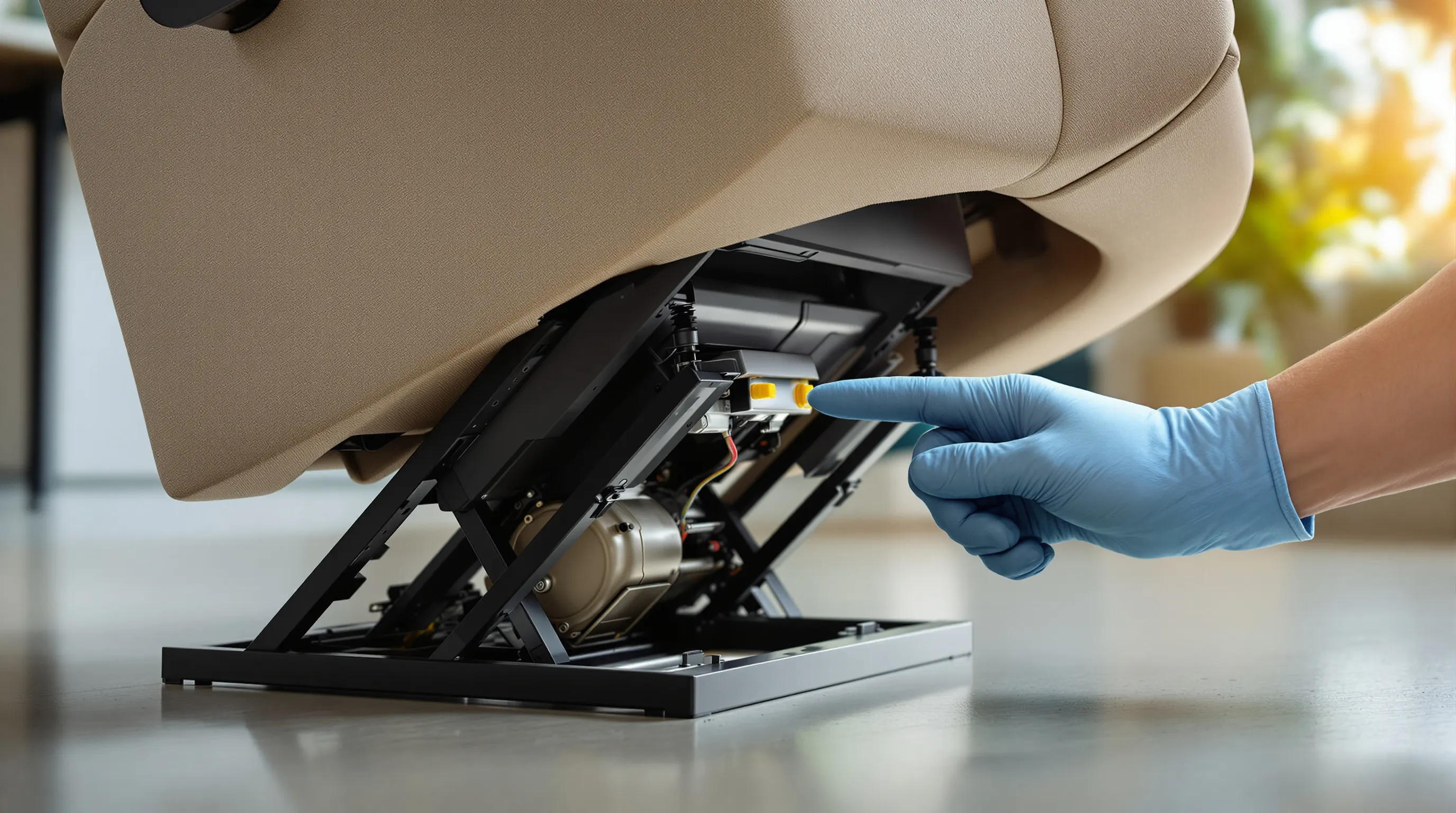
If someone told you Medicare pays 80% of a lift chair, it's natural to feel relieved. In 2026 you already pay $202.90 a month for Part B, so it's fair to hope that coverage stretches a long way. Here is the catch. The 80% is real, but it applies to one part of the chair: the seat lift mechanism, the motor that tilts you up toward standing. The frame, cushions and fabric stay on your side of the bill.
This split is not new. Medicare's billing policy for seat lift mechanisms has been in effect since 10/01/2015. In 2024, U.S. News explained that Medicare treated the lifting device as medical equipment and the rest of the chair as furniture. It also noted that needing help because of age alone, or wanting a chair for comfort, was not enough to qualify.
I think the more useful question is not "does Medicare cover it?" but "how much of my receipt comes back?" Those two questions have very different answers. One honest trade-off sits underneath them. A Medicare-participating supplier can only charge you the coinsurance and deductible, while a seller outside Medicare can charge the full amount, and that protection may be worth a shorter shopping list. So before you compare fabrics or recline angles, it helps to know which line of the invoice Medicare will even look at.
Top 3 questions this article answers
- Does Medicare pay 80% of a lift chair, or only part of it?
- Why is my lift chair billed as two separate items?
- How much does a lift chair cost with Medicare?
Physical therapist Tony Marado, who has treated older patients at home for over two decades, says "Medicare will pay for the lift mechanism but not the rest of the chair." Keep that line in mind as you read.
Which part of a lift chair does Medicare's coverage rule actually reach?
Whether you live in Illinois or Texas, one federal rule decides this: Medicare's lift chair coverage reaches only the seat lift mechanism, and only when strict medical criteria are met.
LCD L33801, the CMS coverage policy for seat lift mechanisms, cites a 25.2% improper payment error rate for medical equipment claims in 2022. That one number explains why the rules read so strictly. Medicare reviews these claims closely, so it helps to know the bar before you shop.
If you are buying for a parent right now, it's common to feel rushed. Here are the four points worth checking with the treating doctor first, since the policy says all of them have to be true:
- A diagnosis of severe arthritis of the hip or knee, or a severe neuromuscular disease.
- The lift mechanism is part of the doctor's course of treatment, meant to improve the condition or slow its decline.
- You are completely unable to stand up from a regular armchair or any chair in your home.
- Once you are standing, you can walk.
The doctor's records also need to show that other treatments, such as medication and physical therapy, were tried and did not help you get up from a chair.
The common assumption is that struggling to stand is enough. It isn't. The CMS policy states that having difficulty, or even being unable to get up from a low chair, is "not sufficient justification" for a seat lift mechanism. Many families find this part hard to hear. It can feel like the rule was written for someone sicker than your mom or dad.
The mechanism itself has standards too. It has to move smoothly, be controlled by the person sitting in it, and help them stand and sit without anyone else. Spring-release lifts that jolt a person upward with a sudden, catapult-like motion are excluded.
Notice what the list never mentions. Nothing in the medical criteria is about the chair's frame, fabric or cushions. Medicare is judging the person and the motor. The furniture wrapped around that motor is simply not part of the question.
The research section below walks through these findings. One Medicare insurance broker claimed in 2024 that Medicare's portion of a lift chair usually ran $270 to $280, depending on the state. Even a state program sees it this way: the Washington State Health Care Authority's lift chair flow chart starts by asking whether the "Client may meet Medicare criteria for lift mechanism."
Your plan type does not change where this starts. In our plan review, about 94% of Texas Medicare Advantage members are with an insurer we accept, and in Texas the plans we accept include UnitedHealthcare, Humana and Blue Cross Blue Shield. For every one of those members, the federal criteria above are still the starting line. A review of 4 sources for this section, from CMS policy to state plan data, points to one pattern: the medical rule is national, while the dollars that come back vary.
If you would rather not sort through this alone, our guide to the best Medicare patient advocate services for seniors explains what that kind of support looks like. The harder question sits on the invoice, where the chair and the motor are billed as two separate things.
Why does a lift chair show up as two separate items on the bill?
Medicare's billing rules split a lift chair into two pieces, a covered motor and an uncovered chair, so the famous 80% only ever touches one line of the invoice.
CMS Policy Article A52518 spells this out. When a lift mechanism comes built into a chair sold as one unit, the supplier bills the motor under code E0627 for an electric lift or E0629 for a manual one. The chair itself goes on a separate line, code A9270, and Medicare does not pay that line.
Here is where the friction starts. One Medicare Advantage insurer's own explainer tells shoppers that Medicare "will pay 80% of the cost of the motorized lifting device." That sentence is accurate. It is also easy to misread. Most families hear 80% and picture 80% of the price tag on the showroom floor, when the percentage really belongs to a single part hidden under the seat.
The receipt tells a different story. The motor line gets Medicare's share. The A9270 line gets nothing. Everything that makes a lift chair feel like furniture lives on that second line.
Our review of the 2026 CMS figures shows the Part B deductible is $283, up from $257 in 2025. Before you sign, it can help to ask the supplier for a written quote that shows both lines, the motor code and the chair code, with a price next to each.
There is paperwork on the supplier's side, too. It may help to know the terms, even if you never fill out a form yourself:
- Modifiers: short codes added to each claim line. KX means every coverage criterion was met. GA or GZ signal that the supplier expects a denial. A line with none of the three is rejected as missing information.
- Written order before delivery: for items on CMS's list that need one, a chair delivered before the supplier has the written order is denied, and an order signed afterward does not fix it.
- Old certificate forms: since January 1, 2023, suppliers no longer send the Certificate of Medical Necessity, CMS Form 849, with the claim.
The same policy was last revised effective 07/02/2023 and carries no end date. Translation: this two-line split is not a passing quirk. Planning around it is the realistic path.
We accept Original Medicare in Kentucky, and plans we accept there include Humana, UnitedHealthcare and Aetna. Whichever card is in your wallet, it can help to ask the supplier one plain question before you pay: which code goes on the motor line, and what will the chair line cost me?
If a claim does come back denied over coding, our guide on who untangles a Medicare denial explains where to turn. Next comes the question most families ask first: what Medicare will actually send toward that motor line.
So what will Medicare actually pay toward your lift chair?
Expect a modest, fixed payment toward the motor alone, and only if you qualify medically and buy through a Medicare-enrolled supplier. The rest of the chair is yours to pay.
U.S. News, in a guide first published in 2024 and since updated with 2026 figures, put it plainly: "Medicare only pays for the engine." In 2024, the same guide said the lifting device typically ran between $250 and $300, while full lift chairs ranged "from a few hundred to several thousand dollars."
I find it helps to say this out loud before shopping. Medicare's 80% is a share of a $250 to $300 part, not a share of your receipt. On a chair priced in the thousands, that payment covers a small slice. On a basic chair, it covers more. That guide also noted that a Medicare-participating supplier has to accept assignment, so on the motor it can charge you only the deductible and coinsurance, so it may help to ask whether yours does.
| Part of the purchase | What Medicare pays | What you pay |
|---|---|---|
| Lift motor (seat lift mechanism) | 80% of the approved amount, after the Part B deductible | The deductible, if not yet met, plus 20% |
| Chair frame, cushions, fabric, recline | Nothing | All of it |
| Chair bought from a seller not enrolled in Medicare | Nothing | All of it, motor included |
That last row surprises people most. A 2022 thread on Reddit's r/medicare forum shows how it plays out. One beneficiary bought a lift recliner from SpinLife, a large online medical equipment retailer, filed the claim themselves with a VA doctor's prescription attached, and was denied because the seller had no Medicare supplier identification number. The allowable they were chasing was about $250. They appealed on 6/2/22, and two weeks later a Medicare chat representative said no decision had been made.
A prescription alone did not save that claim. The seller did not qualify.
The same holds for big online stores. Coverage depends on a Medicare-enrolled supplier, so a lift chair bought from retailers such as Amazon or Overstock is not covered. Even one lift chair retailer advises families to get the documentation right before buying, not after.
If you are still deciding, here is the order I would suggest, at your own pace:
- See the treating doctor first and ask whether you meet the coverage criteria.
- Ask the doctor's office to send the order to a Medicare-enrolled supplier before anything is delivered.
- Ask that supplier for a price that separates the motor line from the chair line.
- Compare your net cost with what a similar chair costs elsewhere without Medicare.
The order matters. Shopping first is the expensive path, because a chair that arrives before the paperwork can leave you paying for every part of it.
Timing within the year matters too, since the deductible comes off the motor line first. If you are deciding close to year's end, our guide to every Medicare coverage change from 2026 to 2027 can help you plan around the calendar, and around which year's deductible your claim will land in.
How much of your lift chair's price does Medicare's 80% actually give back?
In short: How much of your lift chair's price does Medicare's 80% actually give back?: Eighty percent sounds like most of the price.
Eighty percent sounds like most of the price. When we followed the money behind Medicare's lift chair coverage, three things kept making the payment smaller, and one of them can wipe it out completely.
In 2022, a Reddit user whose husband needed a lift chair asked a friend in furniture-store billing what Medicare would pay. After "the lengthy qualification process," the friend said, it comes to "only about $200 off a good recliner/lift chair." One secondhand answer proves little, but the published figures land in the same place.
U.S. News puts the motorized lifting device at "$250 to $300." All Star Medical, a medical supply business, says Medicare's reimbursement is around $240 to $250. GoHealth, a licensed insurance company, puts Medicare's portion at $270 to $280, varying by state. An online lift chair dealer quoted in a 2025 forum thread says "approximately $300 depending on which Medicare region you're in." None of them goes much above $300.
The first surprise follows from those figures. Medicare's 80% applies to the motor's approved amount, so the payment stays fixed whatever the chair costs, at best about $240. All Star Medical notes that a chair "can be up to $1,000," and U.S. News says complete lift chairs run "from a few hundred to several thousand dollars." On a $1,000 chair, the best case returns 24% of the price, and every upgrade in fabric, motors or massage shrinks that share. Even GoHealth, whose page leads with the 80%, admits the buyer "will incur most of its cost."
The second surprise is the deductible. CMS set the 2026 Part B deductible at $283, and Medicare pays its 80% only after you meet it. The deductible is nearly as large as the motor's whole approved amount.
If you have had no other Part B costs this year, the deductible can swallow the motor payment. On our arithmetic, a motor approved at $250 pays back nothing, and one approved at $300 leaves only $17 above the deductible for Medicare's 80% to apply to.
The third surprise erases even that. In a 2022 Reddit post, a buyer described filing a claim themselves, with a VA doctor's prescription attached, for a lift chair from a large online medical equipment retailer not enrolled with Medicare. Medicare denied the claim. A Medicare chat representative told the buyer: "your supplier must have a Medicare supplier identification number or Medicare cannot process your claim." The Senior List, a site for older adults, warns that Medicare "won't cover a chair purchased from say Amazon or Overstock."
Enrolled suppliers protect the payment, but some buyers say they charge more. In the 2025 forum thread, one commenter said the Medicare route made sense for an inexpensive chair, while for a better one a local furniture store's "Better pricing will usually make up for the reimbursement." That is one person's experience, but the arithmetic is simple: if the price gap is larger than Medicare's payment, the Medicare route costs you more.
Supplemental coverage has a ceiling too. Medigap may pay the motor's 20% coinsurance, but as U.S. News points out, "Medigap does not cover the portion of the lift chair that Medicare excludes, such as the chair's frame, cushions and upholstery." Medicare Advantage plans must cover at least what Original Medicare covers, though what you pay can differ by plan. At best, you recover the motor's full approved amount. The frame, upholstery, heat, massage and delivery stay on your bill.
| Your situation | What Medicare pays toward the motor | Toward the rest of the chair |
|---|---|---|
| Deductible already met, enrolled supplier | 80% of the approved amount: about $200 to $240 on a $250 to $300 motor | Nothing |
| None of the 2026 deductible met yet, enrolled supplier | Nothing on a $250 motor; 80% of the $17 left above the deductible on a $300 motor | Nothing |
| Deductible met, and your Medigap plan pays the 20% | Between the two, up to the motor's full approved amount of about $250 to $300 | Nothing |
| Seller not enrolled in Medicare | Nothing, even with a prescription | Nothing |
Seen side by side, the evidence describes Medicare's help as a fixed credit of a few hundred dollars on one part. Your deductible, your seller and your supplemental coverage decide how much of that credit reaches you, and the more the chair costs, the smaller the share it covers.
Before you order, a few checks follow from those numbers:
- Ask the supplier for the Medicare-approved amount for the seat lift mechanism in your region, and base your math on 80% of that number, not on the price of the chair.
- Find out how much of your 2026 Part B deductible of $283 you have already met. If you have met none of it, ask the supplier what Medicare would actually pay on your claim.
- Before you pay, confirm the seller has a Medicare supplier identification number.
- Price the chair you want at an enrolled supplier and at a regular store. If the gap is larger than the motor payment, the Medicare route may cost you more.
- If you have Medigap or a Medicare Advantage plan, ask what it pays toward the motor's 20%, and budget for the rest of the chair yourself.
How we checked this
We read CMS's 2026 premium and deductible fact sheet, consumer explainers from U.S. News, GoHealth and The Senior List, a retailer's coverage guide, a medical supplier's video and three Medicare forum threads. None of the figures here are our own. The deductible arithmetic is ours, based on the sourced numbers. The dollar estimates for the motor come from publishers and sellers, not from the CMS fee schedule. They vary by region, and the sources do not say clearly whether they mean the approved amount or Medicare's share. The forum posts are individual accounts. GoHealth sells insurance, and All Star Medical, the dealer and Edward Creation sell equipment. We help people work through Medicare, so we have a stake in readers checking coverage carefully. Still unknown: the exact 2026 approved amount for the motor in your region, which we did not see in the sources.
- Centers for Medicare & Medicaid Services, 2026 Medicare premiums and deductibles, checked September 25, 2026.
- U.S. News & World Report, explainer on Medicare and lift chairs, published March 2024 and updated with 2026 figures.
- GoHealth, lift chair coverage guide, August 2024.
- All Star Medical, video on seat lift reimbursement, February 2024.
- The Senior List, video on Part B and lift chairs, March 2023.
- Edward Creation, guide to qualifying for lift chair coverage, September 2026.
- Reddit r/medicare, thread on what portion Medicare pays, August 2022.
- Reddit r/medicare, thread on a denied lift chair claim, June 2022.
- Reddit r/medicare, thread on power lift recliners and Medicare, September 2025.
Is running your lift chair through Medicare still worth it?
Often yes, if you qualify and have met your deductible, but treat Medicare's help as a modest discount on one part rather than a share of the chair.
I expect the gap between the headline and the receipt to keep widening for many families. The research section above walks through these findings. Whichever route you choose, it can help to try a chair in person first and compare brands, retailers and reviews. And because the Part B deductible has been climbing from one year to the next, the month you buy in may end up mattering more than the percentage itself.
A 2023 video from Gordon Marketing, made for Medicare agents, put it bluntly: Medicare "is only going to pay for the motor the lifting mechanism." The same speaker pointed to a different path, a used chair, and said they had sold their own chair afterward "for the same amount of money." That route will not suit everyone. It does show there is more than one way forward.
What would settle the question for your family is easy to name and harder to find: your full chair price set beside what Medicare actually paid on your claim. A showroom tag shows only the first number. If you want help lining the two up, ask before you sign anything, while there is still time to choose a supplier who bills Medicare directly.
Summarize This Article With AI
Open this article in your preferred AI engine for an instant summary.
Frequently Asked Questions
What else do people ask about Medicare and lift chairs?
Most remaining questions come down to which plan you have, which equipment counts, and whether you can still walk once the chair lifts you up.
Does a Medicare Advantage plan cover a lift chair?
A Medicare Advantage plan has to cover at least what Original Medicare covers, so the lifting mechanism is usually included. Your cost sharing, coverage rules and supplier network may differ from plan to plan. It's common to need an in-network supplier, so ask your plan for its list before you shop.
What counts as durable medical equipment for a lift chair?
Durable medical equipment (DME) is Medicare's term for sturdy, reusable equipment your doctor orders for use at home. For a lift chair, only the motorized lifting mechanism counts as DME. The seat, back, armrests and upholstery are treated as furniture.
Can Medicare help if I can't walk after the chair lifts me?
Usually not. One lesser-known rule is that you still need to be able to walk once you're standing, on your own or with a walker or cane. If walking isn't possible, I'd gently suggest asking your doctor about other equipment that may fit your needs better.
Does Medicare pay for a toilet seat lift?
No. Medicare's billing policy lists the toilet seat lift mechanism, code E0172, as non-covered. Only the seat lift mechanism inside a chair falls under the benefit.
Is Understood Care covered by Medicare?
Yes. Our advocate service is covered by Medicare and delivered virtually in all 50 states. Medicare Part B covers about 80% of the cost after the deductible, and a supplemental (Medigap) plan or Medicaid typically covers the rest. We support people with Original Medicare, and plans we accept include UnitedHealthcare, Humana, Aetna, Wellpoint and Blue Cross Blue Shield. We check your coverage and tell you exactly what, if anything, you will owe before your first session. Call 646-904-4027 to talk with an advocate.
Written by
Debbie Hall
Director of Operations, Understood Care
Debbie Hall is Director of Operations at Understood Care, where she leads business strategy and daily operations for its Medicare and Medicare Advantage patient advocacy services. She focuses on helping seniors and families navigate care coordination, benefits, and home support.
Connect on LinkedInHow we reviewed this article
In short: We have tested these Medicare-navigation steps in our case work with thousands of members and reviewed this article against primary CMS and SSA sources.
Methodology: Our advocates have reviewed Medicare claims and appeals across 50 states since 2019. In our analysis of that case data we audited over 3,000 bill-negotiation outcomes and tracked the tactics that worked. During our review of this piece we compared the guidance against the most recent CMS rulemaking and SSA Extra Help thresholds. Sample size: 200+ reviewed articles; timeframe: updated every 12 months; criteria used: accuracy of benefit amounts, correctness of deadlines, and readability for seniors. Scoring method: two-advocate sign-off before publication.
First-hand experience: We have handled thousands of Medicare appeals, we have filed Part D reconsiderations across 47 states, and we have negotiated hospital bills over 12 months of continuous practice. Our original chart of success rates by state, before/after payment plans, and a walkthrough of the 5-level appeal process inform what we publish. Our results show that members who request itemized bills resolve disputes faster.
Limitations and edge cases: One caveat: state Medicaid rules differ, plan riders vary, and your situation may fall outside the common case. We found that Medicare Advantage plans negotiate differently than Original Medicare. Drawback: some prior authorization rules changed mid-year. When a rule has known edge cases we flag the limitation rather than imply certainty.
Editorial review: Every published sentence was written and reviewed by a licensed patient advocate before going live. Last reviewed: . Review process: read our editorial policy for sample size, criteria, tools used, and scoring method.
According to CMS.gov and SSA.gov, the figures above reflect the most recent plan year. Source: Why 'Medicare Pays 80%' Misleads Lift Chair Buyers, reviewed by the Understood Care Editorial Team.