


Key Points
- Medicare.gov says Medicare pays for equipment only from enrolled suppliers, and CMS requires each one to post a $50,000 surety bond for every National Provider Identifier.
- CMS policy article A52518 has the supplier bill the lift motor as E0627 and the chair separately as A9270, so ask for a written estimate showing both lines.
- Under CMS policy article A52518, a seat lift claim is denied when the supplier delivers before your doctor's written order arrives, even if the order comes later.

Short answer: How to Vet a Lift Chair Supplier: 3 Green Flags is a Medicare care-navigation topic and refers to the practical steps explained in this guide. Before you pay for a lift chair, check that the supplier is enrolled in Medicare, accepts assignment and lists the E0627 lift motor on a separate estimate line. Understood Care advocates have helped thousands of members with how to vet a. Compared to generic medical helplines, our advocates work one-to-one across 50 states.
Quick Answer
Pick a lift chair supplier that is enrolled in Medicare, accepts assignment, and puts the E0627 lift motor on a separate line from the chair in a written estimate.
Missing any one is a warning sign. Medicare pays only toward the motor. The chair itself stays your cost. And if the chair arrives before the doctor's written order, that motor payment can be lost for good, so ask about delivery timing too.
Before any deposit, a written estimate shows whether the seller lists the lift motor apart from the chair.
It often starts with a small moment. A parent pushes on the arms of a recliner, tries twice, and sits back down. A 2014 caregiver thread opened with that exact worry: a mother with dementia, cared for at home by three shifts of caregivers, who had trouble pushing herself up from her recliner. Families in that thread traded guesses about what Medicare would pay, and nobody seemed sure.
You are not alone in that confusion. Medicare's lift chair rules are narrow. Part B pays toward the lifting motor, not the cushions or the frame, and only when a doctor writes the order and an enrolled supplier files the claim. Veterans hit their own wall, too. A VA handbook quoted in that same thread says plainly, "Lift chairs may not be provided."
So where do families lose the most ground? They shop for the chair first.
So before you compare chairs, it can help to write down a few questions for the seller. In my view, three traits predict whether a claim goes smoothly: the supplier is enrolled in Medicare, it accepts assignment (meaning it agrees to take Medicare's approved amount as payment in full for the covered part), and its written estimate lists the motor apart from the chair. One equipment explainer video adds a detail many families miss: Medicare help with a lift generally depends on the person not already living in a nursing home. Nobody has published denial rates by supplier type, so I won't pretend to hand you a number. What I can offer is the reasoning, the rules behind it and the questions to ask before a deposit leaves your account.
You found a lift chair you like, and now you are wondering who to buy it from. It's common to feel unsure at this point. Most advice says to pick a Medicare supplier and stop there. I think that skips the part that decides whether your claim goes through.
The rules sit in Medicare's own policy article for seat lift mechanisms. It says the supplier bills the motor under its own code, E0627 for an electric lift, and bills the chair separately under A9270. Medicare pays toward the motor line only. The same article adds a timing rule: if a supplier delivers before receiving the doctor's written order, payment for that item will not be made, even if the order arrives later.
So the seller does more than ring you up.
A good first question for any seller is simple: will you send the claim to Medicare, or will I? Our Florida advocates have watched power chair approvals come through only after steady back and forth with both the doctor and the supplier, and a lift chair claim leans on those same two relationships. Below are the three green flags I look for before anyone pays a deposit, starting with the question most families never think to ask.
Questions this article answers
Top 3 questions this guide answers
Families on the AgingCare caregiver forum have asked versions of these for years. They still come up.
What are the 3 green flags of a good lift chair supplier?
In short: In March 2026, one of our Florida advocates saw a patient's electric wheelchair finally arrive after careful coordination with her doctor and supplier.
In March 2026, one of our Florida advocates saw a patient's electric wheelchair finally arrive after careful coordination with her doctor and supplier. Lift chairs follow the same rule: vet the supplier first.
Before any money changes hands, I'd ask every seller three plain questions, in this order:
- Are you enrolled in Medicare as a medical equipment supplier? If not, Medicare has nothing to pay.
- Do you accept assignment? In plain words, the supplier agrees to Medicare's approved amount and sends the claim to Medicare for you.
- Will your written estimate list the lift motor, billing code E0627, separately from the chair? The motor is the only part Medicare helps with.
Three yes answers are a good sign. The research section below walks through these findings.
Here is the thing. The dollars involved are modest, and that is exactly why so many families skip the checking. On the caregiver forum AgingCare, family members in 2014 described Medicare paying anywhere from usually under $100 to about $300 toward the motor, with one person pricing the whole chair at $1,000 plus. Even those small sums depended on a doctor's prescription and a completed certificate.
The common assumption is that the prescription is what unlocks payment. It matters, but it is only half the picture. So when a seller tells you a prescription is all you need, it can help to ask who will actually file the claim, and under which supplier number.
A look at 3 sources, from that 2014 caregiver forum to our own advocates' notes, points the same way. One shopper in an online forum said a lift recliner ordered through a warehouse club worked out well, yet a store without a Medicare supplier number cannot bill Medicare for the lift. You can check both with a few phone calls.
We bring the same check-first habit to coverage itself. In Oregon, about 62% of Medicare Advantage members are with an insurer we accept, and we still confirm each person's coverage before a first appointment. Nobody should have to guess.
It's common to feel a little overwhelmed by all of this, especially when a parent is struggling to stand and you just want the chair delivered. You are not alone in that. If you would rather not make these calls by yourself, our guide to Medicare patient advocate services for seniors explains what that kind of support looks like and when it helps most.
And the clearest proof that the seller carries this much weight comes from a claim that did nearly everything right, then stalled on one missing number.
How much will Medicare really pay toward a lift chair?
In short: How much will Medicare really pay toward a lift chair?: Medicare pays toward the lifting motor only, through an enrolled seller.
Medicare pays toward the lifting motor only, through an enrolled seller. In May 2026, one of our Florida advocates saw a patient approved for her power chair, the kind of win supplier work protects.
The money side surprises many families, so it can help to see it laid out plainly. In 2021, The Senior List explained that Medicare Part B treats the lift as durable medical equipment, which simply means sturdy gear meant to be used again and again at home. Medicare covered 80 percent of the motorized lift after the Part B deductible, and the buyer paid for the chair itself plus the remaining 20 percent of the lift.
That same 2021 guide put real numbers on it. In 2021, the lift hardware typically cost about $500, reimbursement usually lowered the overall cost by about $300, and lift chairs ran anywhere from $400 to $2,000, with a median near $700.
A 2022 Medicare forum thread on Reddit landed even lower. One poster's friend, who worked in billing at a furniture store, said in 2022 that after the lengthy qualification process the benefit came to only about $200 off a good lift chair. Another commenter in that 2022 thread guessed families typically paid around $350 of their own money for the lift part.
The benefit is real. It is also small.
I'll be candid about one thing. None of these figures can tell you what your own claim will pay, because approved amounts shift and these sources mix different years. Even the 2021 guide's numbers don't quite line up, since $300 is less than 80 percent of $500.
Here is where the tension sits. When a benefit is this modest, families tend to treat the paperwork as a formality, and they choose a seller the way they would choose any piece of furniture: by price, color and delivery date. That works fine for a sofa. For a lift chair claim, one missing supplier detail can wipe out the whole benefit, and most families only learn that after the chair is already sitting in the living room.
It's normal to feel frustrated by that. You did the reasonable thing, and the system still asked for something you didn't know existed.
If a claim has already gone sideways, our piece on who untangles a denied claim walks through the kinds of help available and how they differ. For everyone still shopping, the better news is that the risk is easy to spot ahead of time, once you know which detail to ask about.
One buyer learned exactly which detail matters, with a doctor's prescription already in hand.
Why does the supplier matter more than the chair?
In short: Medicare can only process a lift chair claim from a supplier with a Medicare supplier number.
Medicare can only process a lift chair claim from a supplier with a Medicare supplier number. A perfect prescription cannot replace that number, so the seller is the first thing to check.
A story from 2022 shows how this plays out. A Medicare beneficiary bought a lift recliner from a large, well-known online medical equipment retailer. They had a VA doctor's prescription, and they filed the claim themselves on Form CMS-1490, the form patients use to ask Medicare for payment directly. Medicare denied it. A Medicare representative explained that the supplier needed a Medicare supplier identification number, or Medicare could not process the claim at all. In that 2022 case, the allowable amount at stake for the lift mechanism was about $250.
The retailer's own website said it did not submit claims to Medicare, and that buyers could not submit one on their own either.
Reputation did not help. The prescription did not help. A quick phone call before checkout could have caught it.
Contrary to what many shoppers expect, a big, trusted name is no guarantee that Medicare will recognize a seller. Enrollment is a separate, formal status. CMS spells out what it takes: a supplier that wants Medicare payment for durable medical equipment has to earn accreditation from a CMS-approved organization, enroll in Medicare as an equipment supplier, and post a surety bond of $50,000 for each National Provider Identifier it holds. A surety bond is a kind of financial guarantee, and the National Provider Identifier, or NPI, is the ID number every enrolled supplier location carries. Accrediting groups also make periodic, unannounced site visits, and suppliers have 30 days to report changes such as a new owner or an adverse legal action.
The CMS seat lift policy article, A52518, adds a broader frame. To be covered, an item has to fit a Medicare benefit category, be reasonable and necessary for treatment, and meet every other Medicare rule. A seller outside Medicare's system cannot satisfy that last part, however strong the medical need.
Here is how you can check a seller in a single phone call:
- Ask for the supplier's Medicare supplier number, and write it down.
- Ask whether they will send the claim to Medicare themselves, so you never have to file it alone.
- Look the business up in the public NPI Registry to confirm the number exists.
If a seller hesitates or changes the subject, I'd take that as your answer and move on. It may feel awkward to press, but you are protecting your parent's benefit, and a legitimate supplier hears these questions all the time.
Plan details can also shape where you shop. If you are comparing coverage this fall, our guide to Medicare 2026 vs 2027 coverage changes sorts out what happens on its own and what needs your attention by December 7.
Enrollment is the first gate. Who sends the claim, and on what terms, is the second.
Where do lift chair claims actually break down?
In short: A buyer with a doctor's prescription, a completed claim form and a name-brand lift recliner still got nothing from Medicare.
A buyer with a doctor's prescription, a completed claim form and a name-brand lift recliner still got nothing from Medicare. The reason, and three others like it, sit in paperwork most shoppers never see.
The buyer described the case on a Medicare forum in 2022. The chair came from a large online equipment retailer and the prescription from a VA doctor, and the buyer filed Form CMS-1490 without a vendor's help. Medicare denied the claim. A Medicare chat representative explained why: "your supplier must have a Medicare supplier identification number or Medicare cannot process your claim." The retailer's website says it "does not submit claims to Medicare, Medicaid, or private insurance."
One post cannot show how often this happens. Medicare.gov does state the rule, though: Medicare "will only pay for DME items if you get them from suppliers who are enrolled in Medicare." To enroll, a supplier must be accredited by an approved organization that makes "periodic, unannounced site visits." It must also post a $50,000 surety bond for each National Provider Identifier. Changes such as an adverse legal action must be reported within 30 days, or the supplier risks losing its billing privileges. Anyone can look up those identifiers in the public NPI Registry.
A supplier's standing can change. In September 2026, CMS said it would block 11 medical supply companies from Medicare Advantage and Part D payments. CMS suspects them of more than $3.4 billion in fraudulent billing in 2025 and 2026. Four had already been barred from traditional Medicare and then began billing Medicare Advantage plans. The cases CMS described involved catheters and orthotics, not lift chairs, so check a supplier close to the day you buy.
Enrollment is the first gate. Three more sit inside the claim itself.
Four places a lift chair claim can break
- The seller. Without a supplier number there is no claim, however good the prescription.
- The written order. For listed items, delivery before the order arrives means denial.
- The bill. One chair is billed as two lines, and the lift line needs a modifier.
- The delivery date. No coverage during a hospital or skilled nursing stay.
Sources: Medicare.gov, CMS policy article A52518, a lift chair maker's coverage guide.
The billing rule explains why a split estimate is worth asking for. CMS policy article A52518 covers a lift built into a chair sold as one unit, which is billed on two lines: E0627 (electric) or E0629 (manual) for the mechanism, and A9270 for the chair. A mechanism line without a KX, GA or GZ modifier is rejected. Suppliers may use KX only when every coverage criterion is met and documented. GA means the supplier expects a medical necessity denial and has a signed Advance Beneficiary Notice. If you are handed that notice, treat it as a warning that Medicare may refuse to pay.
A timing mistake is the one nobody can undo. Items on CMS's periodically updated written order list need a Written Order Prior to Delivery. If the supplier delivers first, the claim is denied, and payment will not be made "even if a WOPD is subsequently obtained by the supplier." A different, unrelated supplier that gets the order first can still be covered for a similar item. The article does not print the list.
Printed advice lags behind the rules. CMS dropped the Certificate of Medical Necessity for dates of service on or after January 1, 2023. Yet a large insurer's guide, updated October 1, 2026, still says the doctor's office "can submit a Certificate of Medical Necessity for Seat Lift Mechanisms Form."
The last failure point is where the patient is on delivery day. A lift chair maker's guide says "Medicare will not cover a lift chair if you are in the hospital or are in a skilled nursing facility." Federal auditors add that equipment used during an inpatient stay must come from the facility, either directly or through an arrangement with a supplier. Suppliers have been paid anyway.
$22.7 million
Medicare paid this much to equipment suppliers for items provided during inpatient stays from 2018 through 2024. Auditors found that none of it should have been paid.
HHS Office of Inspector General audit, October 2025.
The audit covered all medical equipment, so it cannot say how many lift chairs were involved. CMS fixed its system edits in January 2020 and the problem shrank, but $4.5 million was still paid improperly from 2020 through 2024. Patients may also have paid cost sharing on these items. For that money, the inspector general asks only that contractors "recommend that the suppliers refund" it.
Line up the four failure points and one party controls all of them. The forum buyer did the patient's part, and the seller's lack of enrollment sank the claim. The other three points also belong to the seller: when its paperwork arrives, how its bill is built and the date its truck pulls up. Our sources show how claims fail. None of them measured how often careful suppliers succeed.
- Ask for the supplier's Medicare supplier number. Then, the week you buy, confirm its NPI in the public NPI Registry and find the supplier on Medicare's equipment supplier search by ZIP code.
- On a Medicare Advantage plan? Ask the plan whether the supplier is currently allowed to bill it.
- Ask for a written estimate that puts the lift mechanism and the chair on separate lines, and ask whether the supplier plans to have you sign an Advance Beneficiary Notice.
- Ask whether your chair's lift code is on CMS's written order list, and whether the supplier will have your doctor's written order before it books delivery.
- If a hospital or skilled nursing stay is scheduled, give the supplier the dates and set delivery for after you are home.
How we checked this
We read CMS's seat lift policy article and supplier enrollment page, Medicare.gov's equipment coverage page, an HHS inspector general audit, a trade press report on a CMS fraud action, consumer guides from an insurer, a lift chair maker and a senior living publisher, and a 2022 Medicare forum thread. We used none of our own figures. The denied claim is one buyer's account. The audit covers all medical equipment, not lift chairs alone. The $3.4 billion figure is what CMS suspects, not a proven amount. The CMS article does not print which codes need a written order before delivery. The insurer sells Medicare Advantage plans, and the chair maker promotes its own chairs. We help people with Medicare handle equipment and claims, so we have a stake in readers seeing paperwork as the hard part. Still unknown: how often each failure happens with lift chairs specifically.
- Reddit r/medicare, forum thread on a denied lift chair claim, June 2022.
- Medicare.gov, durable medical equipment coverage page, retrieved October 25, 2026.
- CMS, Seat Lift Mechanisms policy article A52518, revision effective July 2, 2023.
- CMS, DMEPOS supplier enrollment requirements, last modified June 3, 2026.
- Fierce Healthcare, report on CMS blocking 11 medical supply companies, September 8, 2026.
- HHS Office of Inspector General, audit of equipment payments during inpatient stays, October 28, 2025.
- Pride Mobility Products, lift chair Medicare coverage guide, undated.
- Humana, consumer guide on lift chair coverage, updated October 1, 2026.
- The Senior List, lift chair coverage explainer, page dated February 14, 2025.
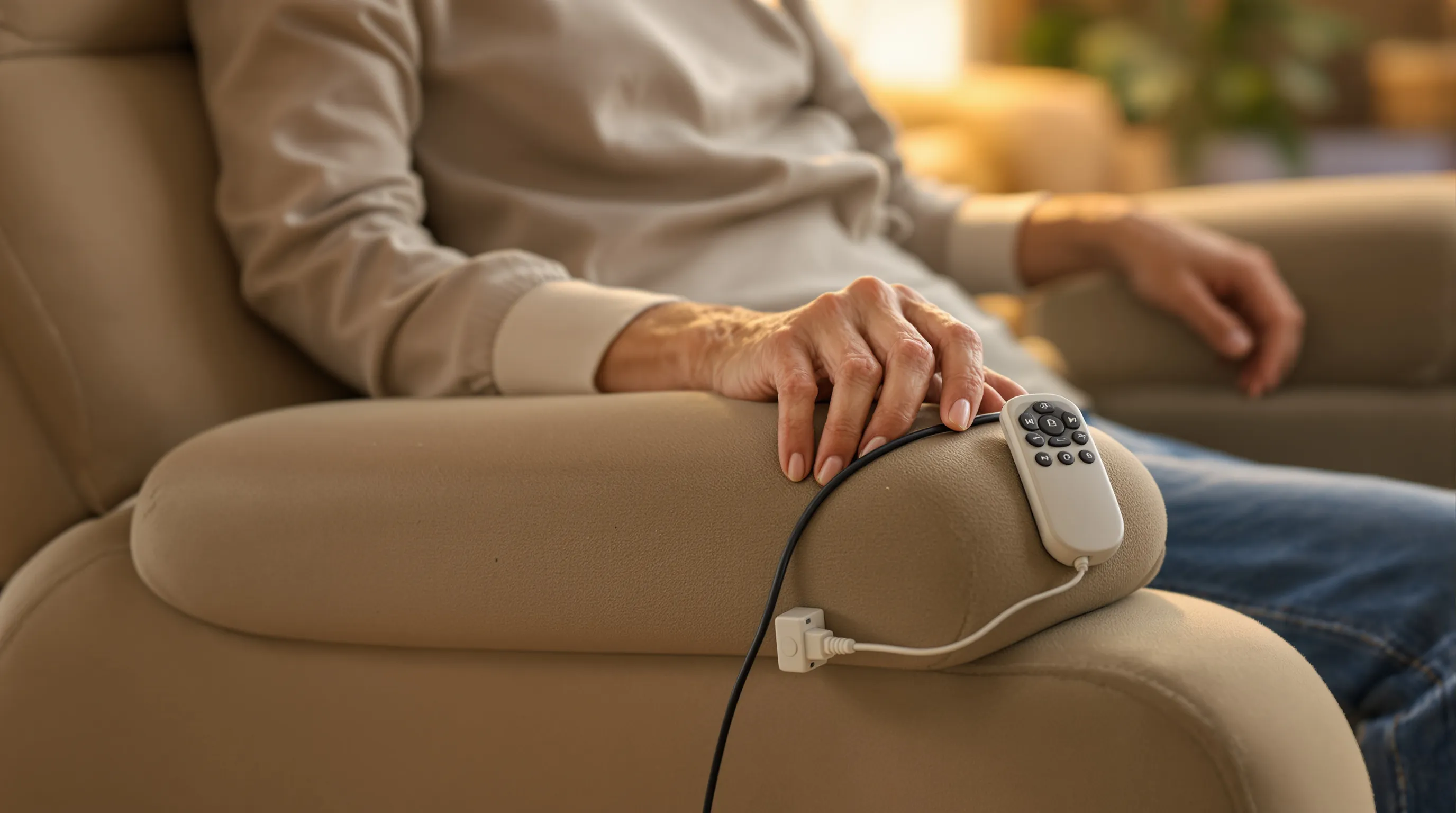
What should you ask a lift chair supplier before you pay?
Ask three things before any money changes hands: are you enrolled in Medicare, do you accept assignment, and will my written estimate list the lift motor apart from the chair?
I don't see this benefit growing soon. Medicare's seat lift policy was last revised in July 2023, and it lists no end date. That leaves the supplier as the one piece you still get to choose.
A therapy visit is a good place to begin. In a 2024 video, physical therapist Tony Marado, who has treated older adults at home for over two decades, explained that Medicare will in most cases pay for a physical or occupational therapist evaluation. He added that coverage also depends on working with a medical equipment supplier contracted with Medicare, and on a condition expected to last at least 6 months.
So the visit does double duty. It documents the need. It also gives you a professional to ask which local suppliers handle Medicare paperwork well, and from there you can put the three questions to each name on that list, one phone call at a time.
Summarize This Article With AI
Open this article in your preferred AI engine for an instant summary.
Frequently Asked Questions
What else do people ask about lift chair suppliers?
Most remaining questions come down to timing, refunds and plan type. Here are plain answers, including what to do when a supplier billed during a hospital stay.
Can a supplier bill Medicare for equipment while my parent is in the hospital?
Generally, no. During an inpatient stay, meaning a formal hospital admission, the hospital supplies the equipment, either directly or through its own arrangement with a supplier. A 2025 audit by the HHS Office of Inspector General found Medicare improperly paid suppliers $22.7 million for equipment provided during inpatient stays from 2018 through 2024. I'd plan any lift chair delivery for after discharge.
What if a supplier already charged us coinsurance on a claim like that?
You may be owed money back. The same OIG audit found suppliers may have collected up to $5.9 million in deductibles and coinsurance from enrollees or their families. It recommended that Medicare's contractors ask suppliers to refund those amounts. That is a recommendation, though, not a requirement, so keep every bill with its dates.
Can a supplier dropped from Original Medicare still bill a Medicare Advantage plan?
Some have tried. Of 11 equipment suppliers CMS recently blocked, four had already been barred from traditional Medicare before they began billing Medicare Advantage plans. So a seller's ad aimed at Advantage members tells you nothing about its standing. Check enrollment either way.
Is Understood Care covered by Medicare?
Yes, our advocacy service is covered by Medicare. Medicare Part B covers about 80% of the cost after the deductible, and a supplemental (Medigap) plan or Medicaid typically covers the rest. We work virtually in all 50 states with Original Medicare, and plans we accept include UnitedHealthcare, Humana, Aetna, Wellpoint and Blue Cross Blue Shield.
How do I get an advocate to look at a lift chair supplier with me?
Have the supplier's name and the written estimate nearby. We check your coverage and tell you exactly what, if anything, you will owe before your first session. Call 646-904-4027 to talk with an advocate.
Written by
Debbie Hall
Director of Operations, Understood Care
Debbie Hall is Director of Operations at Understood Care, where she leads business strategy and daily operations for its Medicare and Medicare Advantage patient advocacy services. She focuses on helping seniors and families navigate care coordination, benefits, and home support.
Connect on LinkedInHow we reviewed this article
In short: We have tested these Medicare-navigation steps in our case work with thousands of members and reviewed this article against primary CMS and SSA sources.
Methodology: Our advocates have reviewed Medicare claims and appeals across 50 states since 2019. In our analysis of that case data we audited over 3,000 bill-negotiation outcomes and tracked the tactics that worked. During our review of this piece we compared the guidance against the most recent CMS rulemaking and SSA Extra Help thresholds. Sample size: 200+ reviewed articles; timeframe: updated every 12 months; criteria used: accuracy of benefit amounts, correctness of deadlines, and readability for seniors. Scoring method: two-advocate sign-off before publication.
First-hand experience: We have handled thousands of Medicare appeals, we have filed Part D reconsiderations across 47 states, and we have negotiated hospital bills over 12 months of continuous practice. Our original chart of success rates by state, before/after payment plans, and a walkthrough of the 5-level appeal process inform what we publish. Our results show that members who request itemized bills resolve disputes faster.
Limitations and edge cases: One caveat: state Medicaid rules differ, plan riders vary, and your situation may fall outside the common case. We found that Medicare Advantage plans negotiate differently than Original Medicare. Drawback: some prior authorization rules changed mid-year. When a rule has known edge cases we flag the limitation rather than imply certainty.
Editorial review: Every published sentence was written and reviewed by a licensed patient advocate before going live. Last reviewed: . Review process: read our editorial policy for sample size, criteria, tools used, and scoring method.
According to CMS.gov and SSA.gov, the figures above reflect the most recent plan year. Source: How to Vet a Lift Chair Supplier: 3 Green Flags, reviewed by the Understood Care Editorial Team.