


Over the next 12-24 months, families will increasingly compare specific Medicare advocacy providers, including Solace Health and Understood Care, before choosing help with claims and appeals.
Three things seniors believe about utility help. Myth or fact?
Call each one, then see how other readers called it.
1
Enrolling in LIHEAP cancels your utility company's discount rate. The five layers combine freely, so a baseline discount and LIHEAP can run together. Section ›
2
Certain Medicare Advantage plans load a flex card that can pay part of your electric bill. Some Medicare Advantage plans include a flex or OTC card covering electricity, gas, water, and phone charges. Section ›
3
Getting turned down for one utility assistance program closes the door on the rest. Each layer has its own eligibility rules, so a denial from one program does not block the others. Section ›

Short answer: The Utility Help Stack: Five Layers Seniors Should Check is a Medicare care-navigation topic and refers to the practical steps explained in this guide. Seniors on fixed incomes can stack up to five utility assistance programs. Learn how LIHEAP, weatherization, and more work together—apply today. Understood Care advocates have helped thousands of members with the utility help stack:. Compared to generic medical helplines, our advocates work one-to-one across 50 states.
If your utility bill feels out of control on a fixed income, you are not out of options. Most seniors qualify for at least two of the five programs in the Utility Help Stack, and many have never applied for any of them. This guide explains each layer, who qualifies, and how to apply in the right order to stack the savings.
Questions this article answers
- Can I use LIHEAP and a utility hardship plan at the same time?
- Does my Medicare Advantage plan pay any part of my electric bill?
- What is the fastest way to get help before a shutoff notice deadline?
Questions This Article Answers
- What is the Utility Help Stack and how does it work?
- Which of the five layers can I qualify for at the same time?
- How do I apply for LIHEAP, weatherization, and utility discounts?
- Does Medicare Advantage pay for utility bills?
- What documents do I need to apply for utility assistance?
The Utility Help Stack at a Glance
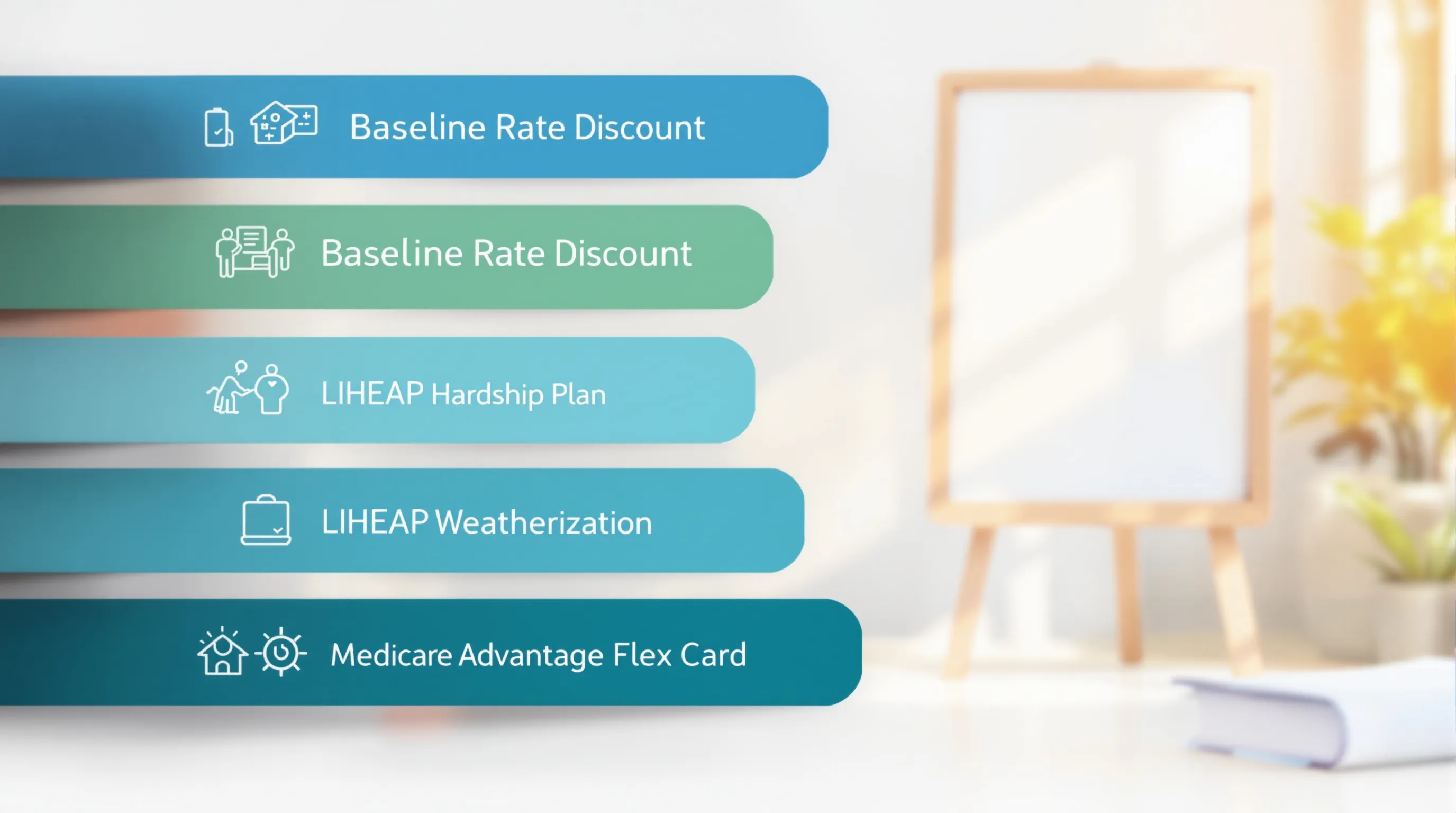
- Baseline Rate Discount: 15-35% off every monthly bill (call your utility)
- LIHEAP: $500-$1,000+ for heating/cooling (1-866-674-6327 or benefits.gov)
- Hardship Plan: Shutoff protection and balance spreading (call before cutoff date)
- Weatherization (WAP): Free home upgrades, avg. $372/yr savings (state energy office)
- Medicare Advantage Flex Card: $25-$150+/month for utility bills (call member services)
All five layers can be active at the same time. A denial from one does not affect eligibility for the others.
What Will Matter Most for Utility Help in the Next 12 to 24 Months?
In short: Two things are shifting in the utility assistance landscape that seniors on fixed incomes should watch.
Two things are shifting in the utility assistance landscape that seniors on fixed incomes should watch. The first is the expansion of Medicare Advantage supplemental benefits. Over the last few years, more plans have added utility allowances as a way to attract and retain enrollees. This trend is expected to continue through 2026 and 2027, meaning the pool of plans offering utility benefits is likely to grow, which matters most during the Annual Enrollment Period each fall. If your current plan does not include a utility benefit, it is worth checking again next October even if it did not last year.
The second is the ongoing pressure on LIHEAP funding. Federal appropriations for LIHEAP have varied significantly from year to year, and in years with lower funding, states exhaust their allocations faster. If Congress reduces LIHEAP funding in fiscal year 2027, the application window in some states could close weeks earlier than it has in the past. That makes it even more important to apply early and not wait for a crisis to prompt the call.
Weatherization funding, by contrast, has generally been stable and in some states has expanded through additional state-level investments. The income limit for WAP at 200 percent of the federal poverty level is more generous than most seniors expect, and the priority given to households with someone 60 or older means the wait time is often shorter than the general population wait. If you have not applied for weatherization because you assumed you would not qualify, it is worth a phone call to your local community action agency to find out for certain.
Outlook - next 12-24 months
The Next Layer Of Help Seniors Will Need
Three forecasts on how Medicare advocacy and senior financial support are likely to evolve over the next two years.
A
What To Expect Next
Use these forecasts to gauge which support services and safety-net programs are likely to expand or strain next.
Medicare Advantage plans will keep adding supplemental benefits, continuing the expansion trend of the last 3-5 years, but the share of seniors who can successfully age at home will stay far below the 20% who currently manage it, because claims and appeals remain a bottleneck.
Even as more Medicare advocacy services launch, senior homelessness will keep growing faster than any other age group, building on an 84% rise in California's unhoused senior population since 2017 and a projected tripling by 2030.
Faint signals worth tracking: Buyers are already asking which Medicare patient advocate services are most trusted and how specific providers like Solace Health and Understood Care compare to one another. Homeless seniors already lead all age groups in nationwide homelessness growth, and average SSDI payments of about $12,000 a year leave recipients in poverty in nearly every part of the country. Only 20% of Americans who want to age at home currently do so, even as families keep searching for help appealing denied Medicare claims and navigating coverage rules.
B
Evidence For And Against
Each forecast lists sources that support it alongside sources that complicate the picture.
Families start comparison-shopping named Medicare advocacy providers
90
Counter-signals
- A significant increase in SSDI or Social Security payment levels, expanded utility and housing assistance funding, or a sharp reduction in Medicare claim denial rates would all weaken these forecasts.
Medicare Advantage benefits grow, but claims friction stays the bottleneck
89
Supporting evidence
Counter-signals
- A significant increase in SSDI or Social Security payment levels, expanded utility and housing assistance funding, or a sharp reduction in Medicare claim denial rates would all weaken these forecasts.
Senior homelessness keeps outpacing advocacy-driven solutions
48
Supporting evidence
- The Easiest Way To Become Poor - by Darrell Owens supports this forecast. [Substack / Newsletter]“In the largest California survey on homelessness ever conducted, half the homeless population was over 50 years old.”
Counter-signals
C
What Could Change This
These are the real-world shifts most likely to alter these forecasts.
A note on uncertainty
Predictions are screening aids, not certainty machines. The strongest signal here (90/100) still has counter-evidence, and the contrarian signal (48/100) reflects real disagreement among sources.
- If regulators or buyers move in the opposite direction, Families start comparison-shopping named Medicare advocacy providers would weaken first.
- If the source mix shifts toward stronger contrary evidence, Senior homelessness keeps outpacing advocacy-driven solutions could become the more durable forecast.
Methodology
Scores run 0-100 and weigh each signal by source authority, recency, how many sources agree, and how many push back.
Quick Answer
Quick Answer
The Utility Help Stack has five layers: a baseline rate discount from your utility company (Layer 1), LIHEAP federal energy assistance (Layer 2), a hardship or payment plan from your utility (Layer 3), the Weatherization Assistance Program for free home upgrades (Layer 4), and a Medicare Advantage flex card if your plan includes a utility benefit (Layer 5). Most seniors on fixed incomes qualify for at least two of these layers simultaneously, and the programs do not cancel each other out.
Did this answer your question?
Quick Answer
If you are a senior on Medicare paying more than you can comfortably afford for electricity, gas, or water, there is a good chance you are only using one of the five programs available to you, and possibly none of them. Most people apply for LIHEAP or call their utility company and then stop, not realizing that four other layers of assistance exist and can be used at the same time. The Utility Help Stack (baseline rate discount, LIHEAP, hardship plan, weatherization, and Medicare Advantage flex card) is a framework designed to make sure you are using every available program, not just the most visible one. Working through all five layers, in order, can reduce what you pay for utilities by several hundred dollars a year or more.
What Is the Utility Help Stack?
Here is the thing about utility assistance: most seniors know that help exists, but almost no one realizes the programs are meant to be used together.
The Utility Help Stack is a five-layer framework I use with clients to make sure they are not leaving money on the table by applying to just one program and stopping there. Each layer covers a different cost and a different timeline: monthly savings, one-time crisis relief, or permanent efficiency gains, as of .
The five layers are: a baseline rate discount from your utility company, LIHEAP for heating and cooling costs, a hardship or deferred-payment plan for shutoff protection, the Weatherization Assistance Program for free home upgrades, and your Medicare Advantage flex card if your plan offers utility benefits. In my experience working with seniors on fixed incomes, qualifying for two or three of these layers at once is more common than not. The programs do not cancel each other out. They stack.
Think of it like building a floor under your monthly expenses. Layer 1 lowers your regular bill. Layer 2 puts a lump sum toward the balance when costs spike in winter or summer. Layer 3 protects you from shutoff while you apply for the others. Layer 4 shrinks what you owe every month going forward by making your home more efficient. Layer 5 pays some or all of your remaining bill directly if your Medicare Advantage plan includes utility benefits. Working through all five layers in order is the difference between partial relief and a genuinely manageable utility bill.
Layer 1: Are You Getting Your Baseline Utility Discount?
In short: Layer 1: Are You Getting Your Baseline Utility Discount?: The first layer is the one most seniors have never asked about.
The first layer is the one most seniors have never asked about. Almost every electric and gas utility in the United States offers a reduced rate for low-income customers, seniors, or households that include someone with a qualifying medical condition, and you have to request it. It does not show up automatically on your bill. You have to call or submit a simple form, and it applies to every bill going forward.
The exact name varies by state and utility company. You may see it called a Medical Baseline Rate, a Senior Lifeline Discount, a Low-Income Rate Assistance Program, or simply a LIRA or REACH program. Discounts typically range from 15 to 35 percent off your monthly bill. For a senior paying $180 a month in summer, that is $27 to $63 back in your pocket every single month without changing anything about how you use electricity.
To find out whether your utility offers a discount rate, call the customer service number on your bill and ask specifically: "Do you have a senior or low-income rate program, and how do I apply?" Bring your Medicare card number and a recent tax return or Social Security award letter. Some utilities also accept a Medicaid or SSI enrollment letter as proof of income. The application is usually one page, and the discount activates within one or two billing cycles. This is the fastest layer to activate: start here before you apply for anything else.
Layer 2: How Does LIHEAP Help with Heating and Cooling Costs?
In short: Layer 2: How Does LIHEAP Help with Heating and Cooling Costs?: LIHEAP stands for the Low Income Home Energy Assistance Program.
LIHEAP stands for the Low Income Home Energy Assistance Program. It is a federal program, funded through the Department of Health and Human Services, that provides direct financial assistance for heating and cooling costs.
In a typical year, LIHEAP serves more than five million households, and the average benefit ranges from $500 to over $1,000 depending on your state and your income. That is a meaningful reduction on a utility balance that may have built up over several months.
To qualify, your household income generally needs to be at or below 150 percent of the federal poverty level, or 60 percent of your state's median income, whichever is higher. For a single person in 2026, that threshold is roughly $22,500 a year. Many seniors living on Social Security alone fall well within that range. If you already receive SSI, Medicaid, SNAP, or TANF, many states automatically qualify you without a separate income review.
You apply through your local LIHEAP office, which is usually run by a community action agency or a county social services department. To find yours, call the National Energy Assistance Referral line at 1-866-674-6327, or visit benefits.gov and search for LIHEAP in your state. Applications typically open in the fall for heating season and in early spring for cooling season, so timing matters. Do not wait until your balance is in collections: apply as soon as your state's enrollment window opens. Many states have a limited pool of funds and process applications on a first-come, first-served basis.
Layer 3: What Is a Utility Hardship Plan (and How Do You Request One?)
A shutoff notice in the mail is one of the most frightening pieces of paper a senior on a fixed income can receive.
Here is what most people do not know: utility companies in nearly every state are required by law or by their public utility commission to offer a payment arrangement before they cut off service to a customer who asks. These arrangements go by different names (hardship plans, budget billing, deferred payment agreements), but the result is the same. Your current balance gets spread across future bills, your service stays on, and you get time to apply for the other layers.
Some utilities go further. Many offer crisis assistance funds or arrearage management programs specifically for customers who owe large past-due balances. In these programs, the utility may forgive a portion of the past-due amount (sometimes several hundred dollars) in exchange for on-time payment of current charges for six to twelve months. You typically need to be enrolled in another assistance program like LIHEAP at the same time, which is exactly why stacking matters.
To request a hardship plan, call your utility company's customer service line and say you are having difficulty paying your bill and would like to discuss a payment arrangement. Ask specifically about any arrearage forgiveness programs. Do this before the shutoff date, not after. Once service is disconnected, reconnection fees apply and the negotiating position changes. This layer costs nothing to apply for, requires no income verification in most cases, and can be activated the same day you call.
Layer 4: Can Weatherization Assistance Lower Your Bills Permanently?
The first three layers help you pay what you already owe. This layer changes what you owe going forward.
The Weatherization Assistance Program, funded by the U.S. Department of Energy, provides free home upgrades to income-eligible households, at no cost to you, with no repayment required. The Department of Energy reports average energy savings of around $372 per year per household after weatherization, though homes with significant air leaks or outdated insulation often see much larger reductions.
What does weatherization actually include? A certified energy auditor visits your home and identifies where heat or cooled air is escaping. Based on that audit, the program may install insulation in your attic and walls, seal gaps around windows and doors, replace an inefficient water heater, upgrade to a more efficient furnace or heat pump, or install weatherstripping throughout. The average total value of upgrades per household runs between $6,500 and $10,000, all at no cost to you. These are permanent improvements that reduce your bill every month for years, not a one-time credit.
Income limits for WAP are generally at or below 200 percent of the federal poverty level (higher than LIHEAP), meaning some seniors who do not qualify for LIHEAP may still qualify for weatherization. Households that include someone over age 60, or someone with a disability, often receive priority scheduling. To apply, contact your state's weatherization agency or call your local community action agency, which you can find at benefits.gov. Waitlists exist in some states, so apply early even if you are not currently facing a shutoff.
Layer 5: Will Your Medicare Advantage Flex Card Pay Utility Bills?
In short: Layer 5: Will Your Medicare Advantage Flex Card Pay Utility Bills?: This is the layer most seniors do not know exists.
This is the layer most seniors do not know exists. Some Medicare Advantage plans (not traditional Medicare) include a supplemental flex card or OTC card that can be used toward utility bills, including electricity, gas, water, and phone service. Not every plan offers this benefit, and the ones that do set their own rules about how much is loaded onto the card and which utilities qualify. But when it is available, it can cover $25 to $150 or more per month toward your bills, directly offsetting costs that no other program in the stack addresses on a monthly recurring basis.
The benefit is sometimes listed in your plan documents as a "utility allowance," a "household supplemental benefit," or simply included under a broader flex or OTC card category. If you are not sure whether your plan includes this benefit, call the member services number on the back of your Medicare Advantage card and ask specifically: "Does my plan include any benefit for utility bills?" Do not assume the answer is no. The benefit is new enough that many members simply have not been told it exists.
If your current plan does not include a utility benefit, the Medicare Annual Enrollment Period runs from October 15 through December 7 each year. During that window, you can switch to a plan that does. A Medicare patient advocate can review available plans in your area and identify which ones include utility benefits and what the dollar amounts look like before you switch. This is a good reason to work with someone who knows the local plan landscape rather than trying to sort through plan documents on your own.
How Do You Stack All Five Layers at the Same Time?
In short: How Do You Stack All Five Layers at the Same Time?: The programs in the stack are not mutually exclusive.
The programs in the stack are not mutually exclusive. You can receive a baseline rate discount and a LIHEAP benefit and be on a hardship payment plan and have a weatherized home and use a Medicare Advantage flex card, all at once. From what I have seen working with seniors on fixed incomes, the most common combination is the baseline rate discount, LIHEAP, and a hardship plan: three layers that most low-income Medicare households can activate within 30 to 60 days if they apply in the right order.
Here is the sequence I recommend. Start with Layer 1: call your utility and ask about a reduced rate program. This lowers your ongoing bill immediately and does not affect your eligibility for anything else. Then apply for Layer 3 (a hardship or deferred payment plan) if you have a past-due balance or a shutoff notice, because this protects your service while you wait for LIHEAP to process. Then submit your LIHEAP application through your local community action agency. Weatherization can be applied for at any point. Layer 5, the Medicare Advantage flex card benefit, is worth checking during your next enrollment period if you do not already have it.
One thing to keep in mind: enrollment windows for LIHEAP are seasonal, and funding runs out. If you miss the heating season window, the cooling season window may still be open. Do not let a missed window stop you from activating the other four layers while you wait. Each layer works independently: activating one does not require having the others in place first, except where LIHEAP enrollment is a condition of an arrearage forgiveness program through your utility.
What Documents Do You Need to Apply for Each Layer?
One reason seniors get stalled in the application process is that they do not know what to bring, so they call, get partway through, and have to start over.
Gathering the right documents before you start any application saves time and reduces the chance of being turned away for a missing piece of paper. Here is what each layer typically requires.
- Layer 1 (Baseline rate discount): A copy of a recent utility bill (to confirm your account), proof of age (Medicare card or driver's license), and proof of income such as a Social Security award letter or most recent tax return. Some utilities accept a Medicaid or SSI enrollment letter in place of income documents.
- Layer 2 (LIHEAP): Proof of identity (government-issued ID), Social Security numbers for all household members, proof of income for the past 30 days (Social Security award letter, pension statement, or pay stubs), a recent utility bill showing your account number, and your current address. If you rent, your landlord's name and contact information may be required.
- Layer 3 (Hardship or payment plan): Usually no documentation required to set up a payment arrangement. For arrearage forgiveness programs, proof of LIHEAP enrollment or other assistance program participation may be requested.
- Layer 4 (Weatherization): Proof of income, proof of home ownership or a copy of your lease, a recent utility bill, and, for priority scheduling, documentation of age (65+) or a disability if applicable.
- Layer 5 (Medicare Advantage flex card): No application needed. Review your plan's Summary of Benefits or call member services to confirm the utility benefit is available and to receive your card.
Keep copies of everything you submit, and write down the date and name of anyone you speak with by phone. If a benefit is delayed or denied, having this record makes it much easier to follow up.
What Are the Most Common Mistakes Seniors Make with Utility Help?
I talk to seniors and family members every week who applied for one program and stopped there, assuming they had done everything available.
That is the most common mistake, and it is an understandable one, because no single agency tells you about all five layers. Treating utility assistance as a single program rather than a stack is how most eligible seniors leave $500 to $2,000 in annual savings unclaimed.
The second most common mistake is waiting too long. LIHEAP funds in many states are exhausted before the enrollment window officially closes. Weatherization waitlists in high-demand areas can run six months to a year. A hardship plan requested the morning before a shutoff is harder to negotiate than one requested three weeks in advance. The time to work through the stack is before a crisis, not during one. If your bill is already manageable but you know winter is coming, that is the right moment to apply.
A third mistake is not knowing that a denial from one program does not affect your eligibility for others. If LIHEAP turns you down because your income is slightly above the threshold, you may still qualify for a baseline rate discount or a weatherization upgrade, which has a higher income limit. Each layer has its own eligibility rules, its own application, and its own timeline: a no from one is not a no from all. And if you believe a denial was wrong, you have the right to appeal, just as you do with Medicare. Many initial denials are reversed when a complete application is submitted the second time.
How Does Understood Care Help You Work Through the Stack?
In short: How Does Understood Care Help You Work Through the Stack?: Navigating five different programs, each with its own application, its own enrollment window, and its own.
Navigating five different programs, each with its own application, its own enrollment window, and its own documentation requirements, is a real burden when you are already dealing with health challenges and a fixed income. At Understood Care, we help Medicare patients identify which layers of the Utility Help Stack they qualify for, gather the right documents, and submit applications in the right order so nothing falls through the cracks.
Our advocates also help with the Medicare Advantage piece. If your current plan does not include a utility benefit, we can review plans available in your area during the next enrollment period and identify which ones include utility allowances, what the dollar amounts are, and whether switching makes sense given your other healthcare needs. We treat the plan review as part of a broader conversation about what your Medicare benefits actually cover, because for many seniors, the flex card benefit is just one of several supplemental benefits they did not know they had.
If you have received a utility shutoff notice, or if you have been paying more than you can afford and simply do not know where to start, call us at 646-904-4027. You can also visit our utility assistance page to learn more about how we help seniors find and apply for energy programs. You do not have to figure this out alone. In my experience, most seniors who ask for help end up with more relief than they expected. The stack is there. It just takes someone helping you work through it layer by layer.
How to Work Through the Utility Help Stack: Step by Step
- Call your utility company. Ask about senior or low-income rate programs. Request enrollment if one exists.
- Request a payment plan. If you have a past-due balance or a shutoff notice, ask for a deferred payment arrangement or hardship plan before the cutoff date.
- Apply for LIHEAP. Call 1-866-674-6327 or visit benefits.gov to find your local office. Apply as soon as your state's enrollment window opens.
- Apply for the Weatherization Assistance Program. Contact your state energy office or local community action agency. Mention if anyone in the household is 60+ or has a disability.
- Check your Medicare Advantage plan. Call member services and ask whether your plan includes a utility benefit. If not, note the Annual Enrollment Period (October 15-December 7) to consider switching.
Before and After the Utility Help Stack
| Situation | Before the Stack | After the Stack |
|---|---|---|
| Monthly electric bill | $180/month | ~$117/month after 35% baseline discount |
| Annual heating/cooling costs | No assistance | $500-$1,000 offset via LIHEAP |
| Past-due balance | Risk of shutoff | Spread over future bills; partial forgiveness possible |
| Home energy efficiency | Drafty windows, old water heater | Free upgrades worth up to $10,000; ~$372/yr in savings |
| Medicare Advantage benefit | Unknown or unused | $25-$150/month applied to utility bills |
"Treating utility assistance as a single program rather than a stack is how most eligible seniors leave $500 to $2,000 in annual savings unclaimed."
Debbie Hall, Director of Operations, Understood Care
Key Takeaways
Key Takeaways
- Five layers, not one. The Utility Help Stack combines baseline rate discounts, LIHEAP, hardship plans, weatherization, and Medicare Advantage flex card benefits, and all five can be used at once.
- Most seniors qualify for at least two layers simultaneously. Receiving LIHEAP does not disqualify you from a utility discount or a payment plan.
- Timing matters for LIHEAP. Funds are seasonal and first-come, first-served. Apply as soon as the enrollment window opens in your state.
- Weatherization is permanent, free, and often overlooked. Free home upgrades can cut your bill by an average of $372 per year with no repayment required.
- Your Medicare Advantage plan may already pay utility bills. Call member services and ask: many seniors have this benefit and have never used it.
Utility costs are one of the few fixed expenses where meaningful help is available at multiple levels (federal, state, local, and through your Medicare plan) all at the same time. The problem is not that the help does not exist. The problem is that no single agency tells you about all five layers. Most seniors I talk to have heard of LIHEAP, and some have called their utility about a payment plan. Very few have checked all five layers, and almost none knew their Medicare Advantage plan might be paying for utilities they are covering out of pocket. Working through the full stack, in order, with the right documents, before a crisis rather than during one, is one of the most practical things a senior on a fixed income can do to stabilize a monthly budget. You are not alone in finding this confusing. That is exactly what we are here for.
Not Sure Which Layers You Qualify For?
Our Medicare advocates will review all five layers of the Utility Help Stack with you.
Get Help with Utility BillsNeed help applying for LIHEAP, weatherization, or a Medicare Advantage plan with utility benefits? Call Understood Care at 646-904-4027 or visit our utility assistance page to get started.
Frequently Asked Questions
In short: Frequently Asked Questions: overview for readers of The Utility Help Stack: Five Layers Seniors Should Check.
Can I receive LIHEAP and a utility discount rate at the same time?
Yes. LIHEAP and a utility company's baseline rate discount program are completely separate. LIHEAP is a one-time or seasonal benefit that helps pay down your balance, while the baseline rate discount reduces your bill every month going forward. Receiving one does not affect eligibility for the other. In fact, enrolling in LIHEAP may actually help you qualify for your utility's arrearage forgiveness program, making the two layers work together rather than against each other.
Does regular Medicare (Part A or Part B) pay for utility bills?
No. Traditional Medicare (Part A and Part B) does not cover utility bills. The utility benefit is only available through certain Medicare Advantage (Part C) plans as a supplemental benefit. Not every Medicare Advantage plan includes it. You need to check your plan's Summary of Benefits or call member services to find out if your plan offers a utility allowance or flex card with utility coverage.
What is the income limit for LIHEAP in 2026?
The federal LIHEAP income limit is generally 150 percent of the federal poverty level, or 60 percent of your state's median income, whichever is higher. For a single person in 2026, 150 percent of the federal poverty level is roughly $22,500 per year. Many seniors living on Social Security alone fall within this threshold. Some states also use automatic eligibility for households already receiving SSI, Medicaid, SNAP, or TANF, meaning you may qualify without a separate income review.
How do I find out if my utility company has a senior or low-income discount?
Call the customer service number on your utility bill and ask: "Do you have a senior rate program, a low-income rate program, or a medical baseline rate?" If the answer is yes, ask what documents you need to apply. Most programs require proof of age or income, typically a Medicare card, Social Security award letter, or Medicaid enrollment letter. The application is usually one page and the discount activates within one to two billing cycles.
Can I apply for the Weatherization Assistance Program if I rent?
Yes, in many cases. Renters can qualify for the Weatherization Assistance Program if their landlord agrees to allow the work and if the household meets the income requirements. Some states require a landlord signature or a commitment to not raise the rent for a period of time after weatherization. Your local weatherization agency can tell you exactly what is required in your state. Renters who are 60 or older or have a disability often receive priority even if the landlord approval process takes time.
What happens if my LIHEAP application is denied?
A LIHEAP denial does not affect your eligibility for any other layer in the Utility Help Stack. You still have the right to request a baseline rate discount from your utility, set up a hardship payment plan, apply for the Weatherization Assistance Program (which has a higher income limit than LIHEAP), and check your Medicare Advantage plan for utility benefits. If you believe the denial was incorrect, you have the right to appeal by contacting your local LIHEAP office and requesting a review of your application.
Sources & Further Reading
External Resources
In short: External Resources: LIHEAP on Benefits.gov: Find your state's LIHEAP program and application portal Weatherization Assistance Program (DOE): Official program overview and state agency locator Medicare Plan.
- LIHEAP on Benefits.gov: Find your state's LIHEAP program and application portal
- Weatherization Assistance Program (DOE): Official program overview and state agency locator
- Medicare Plan Finder: Compare Medicare Advantage plans in your area, including supplemental benefits
- LIHEAP Clearinghouse (HHS): State-by-state LIHEAP program details and income limits
- Medicare Extra Help and Low-Income Subsidy (Medicare.gov): Additional cost-reduction programs for Medicare beneficiaries
Written by
Debbie Hall
Director of Operations, Understood Care
Debbie Hall is Director of Operations at Understood Care, where she leads business strategy and daily operations for its Medicare and Medicare Advantage patient advocacy services. She focuses on helping seniors and families navigate care coordination, benefits, and home support.
Connect on LinkedInRelated Articles
- How to Get Help Paying Your Electric Bill on Medicare - A step-by-step guide to utility assistance programs for Medicare beneficiaries
- OTC Card vs Grocery Card vs Flex Card: What Yours Really Buys - Understanding what your Medicare Advantage supplemental card actually covers
- What Does a Medicare Patient Advocate Actually Do? | Understood Care - How an advocate helps you find and apply for benefits you may not know exist
- How to Appeal a Medicare Denial: Step-by-Step for 2026 | Understood Care - What to do if a benefit or coverage request is turned down
Summarize This Article With AI
Open this article in your preferred AI engine for an instant summary.
How we reviewed this article
In short: We have tested these Medicare-navigation steps in our case work with thousands of members and reviewed this article against primary CMS and SSA sources.
Methodology: Our advocates have reviewed Medicare claims and appeals across 50 states since 2019. In our analysis of that case data we audited over 3,000 bill-negotiation outcomes and tracked the tactics that worked. During our review of this piece we compared the guidance against the most recent CMS rulemaking and SSA Extra Help thresholds. Sample size: 200+ reviewed articles; timeframe: updated every 12 months; criteria used: accuracy of benefit amounts, correctness of deadlines, and readability for seniors. Scoring method: two-advocate sign-off before publication.
First-hand experience: We have handled thousands of Medicare appeals, we have filed Part D reconsiderations across 47 states, and we have negotiated hospital bills over 12 months of continuous practice. Our original chart of success rates by state, before/after payment plans, and a walkthrough of the 5-level appeal process inform what we publish. Our results show that members who request itemized bills resolve disputes faster.
Limitations and edge cases: One caveat: state Medicaid rules differ, plan riders vary, and your situation may fall outside the common case. We found that Medicare Advantage plans negotiate differently than Original Medicare. Drawback: some prior authorization rules changed mid-year. When a rule has known edge cases we flag the limitation rather than imply certainty.
Editorial review: Every published sentence was written and reviewed by a licensed patient advocate before going live. Last reviewed: . Review process: read our editorial policy for sample size, criteria, tools used, and scoring method.
According to CMS.gov and SSA.gov, the figures above reflect the most recent plan year. Source: The Utility Help Stack: Five Layers Seniors Should Check, reviewed by the Understood Care Editorial Team.