


Understood Care
Coverage data 2024. Plan networks change - we confirm exactly what your plan covers before any work begins.
 Cheryl Strickland Care Advocate
 From the first call, Cheryl is the same person every time: no call center, no starting over, and no surprise bills.
 T'Keyah Ingram Care Advocate
 T'Keyah works one-to-one with Medicare members on bills, denials, appointments, and benefits, and stays on the case until it is resolved.
 Renee Osborne Care Advocate
 One dedicated advocate with a direct phone and text line: Renee makes the calls and handles the paperwork so you do not have to.
Wisconsin QMB, SLMB, and QI programs pay your Medicare premiums if you qualify. Free SHIP counseling in all 72 counties. See 2026 income limits.
Across the Green Bay area, care runs through Bellin Health, HSHS St. Vincent and St. Mary's, Aurora BayCare, and Prevea Health, so specialty referrals and follow-up coordination take real work. Understood Care is a virtual service: phone, video, and secure messaging. For Howard members that means no waiting room and no travel, whether the problem is a confusing hospital bill, a denied claim, a referral that went nowhere, or a parent in Brown County who needs someone watching their whole picture. Your advocate is the same person every time, follows up every 7 days while your case is active, and still checks in monthly after it is resolved. Many Green Bay Area families also run Wisconsin's IRIS self-directed paid family caregiving alongside Medicare; we handle the Medicare side.
About 17.5% of Howard residents are 65+, close to Wisconsin's statewide 18%. Medicare Advantage runs high here: 70.9% of the county's 56,151 beneficiaries chose MA plans in 2025, above Wisconsin's already high 57.7%. That means more prior authorizations, more network questions, and more denials worth appealing. About 7,060 neighbors are dual-eligible for Medicare and Wisconsin Medicaid, the group most likely to benefit from the state's home-care programs.
Of 8 Medicare-certified homes, 5 rate 4+ CMS stars , a spread an advocate helps families navigate. Highest-rated nearby:
About 1,157 Howard households are a person 65+ living alone, and that is exactly who a dedicated advocate keeps from falling through the cracks. 8.7% of senior households here have no vehicle (about 202 households), which is why a fully virtual advocate, plus Medicare-covered ride benefits where plans include them, matters. Setting up home care, meal delivery, and transportation is core advocate work, covered by Medicare.
About 4.4% of Howard seniors live below the poverty line (Wisconsin: 8.6%), and many more qualify for help they never claim: SeniorCare, federal Extra Help with Part D costs, and the Medicare Savings Programs Wisconsin Medicaid runs. Checking every one of those is standard advocate work. 30.3% of seniors here live with a disability, where equipment orders and prior authorizations pile up fastest. The federal government lists 4 primary-care shortage designations in Brown County, so appointment hunting is a real problem an advocate takes over. Specialized care nearby: 6 Medicare-certified dialysis facilities (avg 4.2/5 CMS stars) and 8 hospice providers.
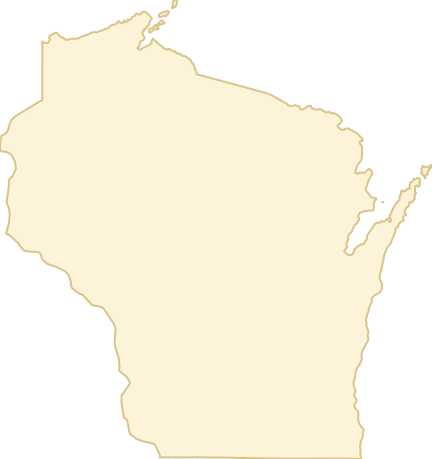
Howard, Wisconsin · Brown County · served virtually statewide
From CMS Care Compare (6 Medicare-certified hospitals in the area; a sample below). ER medians below are CMS-reported; Wisconsin's statewide median is 136 minutes. Billing disputes, discharge planning, and referral follow-ups with these systems are everyday advocate work:
Medigap works differently in Wisconsin than in most states. Wisconsin is one of three states (with Massachusetts and Minnesota) that does not use the federal letter plans. Every policy starts from one standardized Basic plan, which already covers the Part B 20% coinsurance and 40 home health visits a year, and you add riders one at a time, the Part A deductible, Part B excess charges, additional home health care, foreign travel emergency, all regulated by the Wisconsin Office of the Commissioner of Insurance. Because everyone starts from the same Basic plan, Howard members can compare carriers on price, but there is no birthday rule or annual guaranteed-issue window, so a switch outside your six-month open enrollment can be medically underwritten. The Medigap Helpline, Wisconsin's free counseling from the Board on Aging and Long Term Care (reachable at 1-800-242-1060), gives commission-free help to Howard residents. Many Howard seniors also qualify for SeniorCare, federal Extra Help, and the Medicare Savings Programs but never claim them. The full, sourced rundown is on our Wisconsin patient advocacy hub.
Wisconsin's IRIS (Include, Respect, I Self-Direct) program is self-directed: a family member, an adult child for example, can be hired and paid to provide care so a parent can stay home instead of a nursing facility, while their Medicare paperwork piles up. The participant hires and manages their own workers, and Family Care and PACE are the managed alternatives, all reached through your county Aging and Disability Resource Center. That split is exactly where an advocate fits: you handle the caregiving, we handle the Medicare side. See how these fit together on our Wisconsin hub.

Learn how SSBCI may cover ramps, grab bars, and bathroom safety home modifications, plus eligibility basics.
Read more
Learn how Medicare covers home oxygen, portable oxygen, and nebulizers, what paperwork you need, and how advocates help you avoid delays and breathe easier.
Read more
Find nearby social events and senior programs, see how connection supports your health, use trusted tools, and get advocate help with rides and access.
Read more
Three doors, all worth knowing. For free, unbiased counseling on plans and enrollment, Wisconsin's Medigap Helpline (its State Health Insurance Assistance Program), run by the Board on Aging and Long Term Care and reachable at 1-800-242-1060, plus the Elder Benefit Specialists at your county's Aging and Disability Resource Center (ADRC). For local services such as meals, rides, and in-home help, the Eldercare Locator (1-800-677-1116) connects you to the Aging unit and ADRC serving Howard. And for one dedicated advocate who does the ongoing work with you, bills, denials, appointments, and benefits, Understood Care, covered by Medicare for most members and usually $0: call (646) 904-4027 or get started online.
Yes. Medicare has paid for professional healthcare navigation (Principal Illness Navigation and Community Health Integration services) since January 2024. Part B covers about 80% and a Medigap plan typically covers the rest, so most members in Brown County pay $0. We confirm your exact coverage before your first session, and there are no surprise bills.
Per CMS enrollment data for 2025, Brown County had 56,151 Medicare beneficiaries: 39,794 on Medicare Advantage plans (70.9%) and 16,358 on Original Medicare, with about 7,060 dual-eligible for both Medicare and Wisconsin Medicaid. Understood Care advocates work with both: Original Medicare members usually pay $0 through Part B plus a supplement, and we confirm Medicare Advantage coverage plan by plan before any work begins.
Per the US Census Bureau's American Community Survey, about 3,542 of Howard's 20,261 residents are 65 or older (17.5%), within a county of roughly 42,792 seniors (Brown County). Most become Medicare-eligible at 65, and every one of them has the same federal benefits an advocate helps put to work.
Per CMS Timely & Effective Care data (period ending 09/30/2025), the median ER visit at Bellin Memorial Hospital runs about 151 minutes, and local hospitals range 102 to 151 minutes; Wisconsin's statewide median is 136 minutes. An advocate cannot shorten an ER line, but avoiding the ER for non-emergencies is advocate work: same-week appointments, urgent-care routing, and follow-up coordination.
No. Understood Care is fully virtual, delivered by phone, video, and secure messaging, so it works the same in Howard as anywhere else in Wisconsin's 72 counties. If leaving home is hard, that is exactly the situation the service is built for.
Advocates work virtually and are matched to you, not to a zip code. You get one dedicated advocate with their direct phone, email, and text (One Advocate, For Life), and they work with Wisconsin's programs: the state's own Medigap design (a Basic plan you customize with riders, not the federal letter plans A through N), the Medigap Helpline (Wisconsin's free Medicare counseling from the Board on Aging and Long Term Care), SeniorCare (Wisconsin's $30-a-year prescription drug program) and the Medicare Savings Programs Wisconsin Medicaid runs, and the IRIS self-directed paid-caregiving path, plus the county and city services that apply in Brown County.
Those run through Wisconsin Medicaid, not Medicare. Wisconsin's self-directed option, IRIS (Include, Respect, I Self-Direct), lets the participant hire and manage their own workers, and in Wisconsin that worker can be a family member such as an adult child, so a person can stay home instead of entering a nursing facility. Families we serve in Green Bay Area use this pathway, along with Family Care and PACE, alongside Medicare, and reach it through their county Aging and Disability Resource Center. Our advocacy is billed through Medicare, so for dual-eligible families the split works well: you run the caregiving and the Wisconsin Medicaid paperwork, and your parent's advocate handles the Medicare side.
In Wisconsin we are in-network for Original Medicare (traditional fee-for-service Medicare); UnitedHealthcare Medicare Advantage plans (~45% of Wisconsin MA members); Humana Medicare Advantage plans (~12% of Wisconsin MA members); Aetna Medicare Advantage plans (~6% of Wisconsin MA members). Together that covers roughly 78.9% of Wisconsin's Medicare beneficiaries. Market-share data: 2024. Plan networks change, so we confirm exactly what your plan covers before any work begins - no surprise bills.
Green Bay Area
Green Bay · De Pere · Bellevue · Ashwaubenon · All of Wisconsin
Local figures: US Census Bureau American Community Survey (2023, 5-year), CMS Medicare Monthly Enrollment (2025), and CMS Care Compare, retrieved 2026-08-20. Statewide program facts were last verified on 2026-08-20; sources are listed on the Wisconsin hub, and the full county tables are on Wisconsin Medicare by the numbers. Understood Care is an independent private advocacy service and is not affiliated with any government agency or any hospital named above.